Key takeaways
- Ages 2 to 4: The Three Little Pigs, Goldilocks, Little Red Riding Hood and The Gingerbread Man, with refrains and dangers that pass quickly.
- From about 4 come the magic tales of the Brothers Grimm and Charles Perrault, such as Snow White, Cinderella and Hansel and Gretel.
- Many stories known from the movies are older and different: in Grimm there is no kiss for Snow White, and Oz's slippers are silver, not ruby.
- From 6, children enjoy long journeys and irony: The Jungle Book, The Wonderful Wizard of Oz, Nils and The Emperor's New Clothes.
The fairy tales we read to our children are mostly the ones our grandparents read to us, and that is no accident: in a few pages they act out real fears, like getting lost, being left out or not being believed, and they show a way through. Between half-remembered bedtimes, movies and picture-book retellings, though, it is easy to lose track of how a story really goes, what it teaches and when a child is ready for it.
Browse all personalised fairy tale books and pick the one your child will star in.
Below are the classic fairy tales in our library, grouped by age and by theme, each with a short plot, its lesson and the right age. We start from the sources, the Brothers Grimm, Charles Perrault, Hans Christian Andersen and the great storytellers of the 1800s, not from the movies, and we add the American classics that belong on every family’s shelf.
Every tale can be read in full
Every title below leads to the tale’s own page, where you can read the whole story for free, with sample illustrations. If you like, your child can become its hero, drawn from a photo on every page.
Before you choose: age matters more than the title
Between 2 and 4, the stories that work have few characters, lots of repetition and a danger that passes quickly. From 4 to 6, children are ready for magic tales with a real villain, as long as the ending puts everything right. After 6 they enjoy long journeys, irony and even a little sadness, which Andersen never runs short of. A simple test: if your child still asks for the same book every night, pick a tale with a refrain; once they start asking “and then what?”, they are ready for a quest. In our versions the harshest scenes of the originals are softened: the wolf is chased off, not filled with stones, and every story ends well.
First fairy tales: ages 2 to 4
The Three Little Pigs is an English folk tale, first written down in the 1840s and made famous by Joseph Jacobs in 1890: three brothers build houses of straw, sticks and brick, and only the last one stands up to the wolf’s huffing and puffing. The lesson: things done patiently and done properly last. From age 2, thanks to the refrain children love to shout along with.
Goldilocks and the Three Bears first appeared in 1837, written by the English poet Robert Southey, and the intruder was a grumpy old woman; she only became a little girl with golden curls decades later. A child walks into an empty cottage and tries the porridge, the chairs and the beds until the bears come home. It teaches respect for other people’s things and, in our version, how to say sorry. From age 2.
Little Red Riding Hood has two endings. In Charles Perrault’s version (1697) the wolf wins, and Perrault adds a rhyming moral warning girls about smooth-talking strangers; in the Grimms’ version (1812) a huntsman rescues grandmother and granddaughter. In ours, a brave shout and a friendly woodcutter put things right. The lesson stays the same: stick to the path and be wary of strangers who seem too friendly. From age 3, with the happy ending.
The Gingerbread Man is an American tale, published in St. Nicholas Magazine in 1875: a cookie jumps out of the oven and runs from everyone, boasting “Run, run, as fast as you can!”, until he meets a sly fox at the river. In our version the child gets there just in time. Bragging doesn’t get you far, and home is the best place to be. From age 2.
The Town Musicians of Bremen are a donkey, a dog, a cat and a rooster that their owners no longer want. They set off to become musicians and, singing together, scare a gang of robbers out of their house. A fun fact for grown-ups: in the Grimms’ tale they never actually reach Bremen. The lesson: together we are stronger, at any age. From age 3.
The Princess and the Pea is one of Andersen’s shortest tales (1835): a queen hides a single pea under twenty mattresses to find out whether the rain-soaked girl at the gate is a real princess. It makes children giggle and shows that who you really are comes out sooner or later. From age 3.
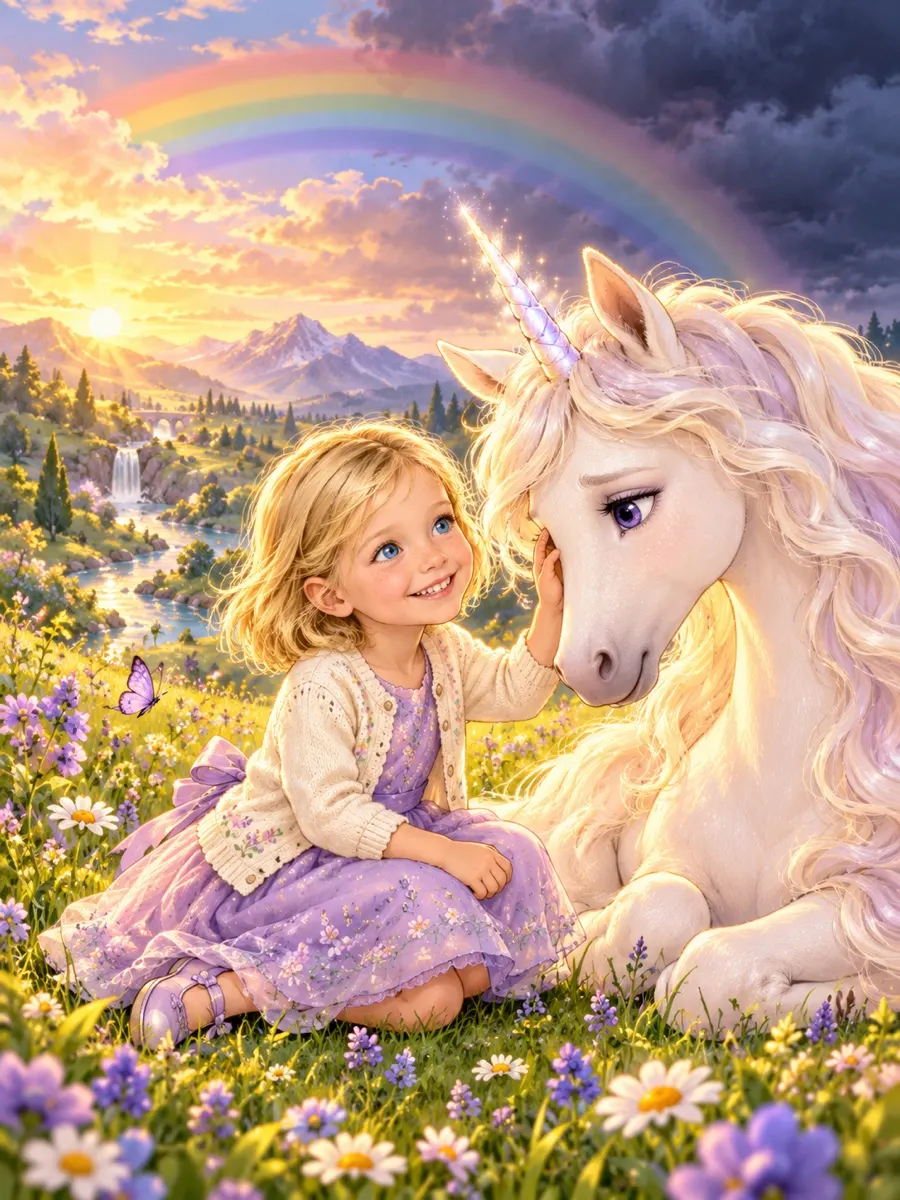
The Unicorn and the Rainbow is a new tale of our own: the rainbow is fading, and the child helps a gentle unicorn find its lost colors. Kindness shines brightest of all. Ages 2 to 5.
The Brothers Grimm: magic tales from age 4
Jacob and Wilhelm Grimm published their Children’s and Household Tales in 1812 and kept revising them until 1857. They collected stories rather than inventing them, and many are darker than the picture-book versions. These work best from about 4.
Snow White flees her jealous stepmother and finds shelter with seven small friends in the forest; the queen comes back three times in disguise, with a bodice lace, a poisoned comb and the apple. In the Grimms’ tale there is no kiss: the piece of apple falls from Snow White’s mouth when the prince’s servants stumble while carrying her glass coffin. It is a story about envy, which hurts the envious most, and about the strength of friendship. From age 4; in our version the friends are seven miners, and the queen storms off and is never seen again.
Hansel and Gretel get lost in the forest, follow their white pebbles home once, and the second time end up at a witch’s house made of bread and cake. Sticking together and using your head will get you home, and not everything sweet is safe. From 4 to 5, because the tension is real.
Can I Meet the Frog Prince? is our take on the very first tale in the Grimms’ collection: a frog fishes a golden ball out of a well in return for a promise, and the king insists the promise be kept. In the original the princess, disgusted, throws the frog against the wall; in ours the frog asks only for friendship, a kind welcome breaks the spell, and faithful Henry’s iron bands still burst with joy. A promise is a promise. From 3 to 4.
Rumpelstiltskin: a miller brags too much, and a strange little man spins straw into gold in return for something very dear, which can only be saved by guessing his name. In the Grimms’ version the price is the queen’s firstborn child; in ours it is the child’s pet lamb. Be careful with promises made lightly. From age 4.
Rapunzel is named after a plant, rampion, that her mother craved from a sorceress’s garden; the sorceress took the baby in return and shut her in a tower with no door. The Grimms’ version goes back, through a German retelling, to “Persinette”, a French tale of 1698 by Mademoiselle de La Force. A tale about freedom and curiosity about the world. From age 4.
Mother Holle: a hardworking girl falls down a well and helps an old woman whose feather bed, when shaken, makes it snow on the world; she comes home covered in gold, and her lazy stepsister comes home covered in pitch. Effort and kindness are rewarded. From age 4.
The Twelve Dancing Princesses wear their dancing shoes to holes every night: a secret stair leads them through forests of silver, gold and diamonds to a castle where they dance until dawn. In the Grimms’ version an old soldier with a cloak of invisibility follows them. A tale about secrets and honesty. From age 5.
Charles Perrault and the French fairy tales
In 1697, at the court of Louis XIV, Charles Perrault published a small book of tales, known ever since as the Tales of Mother Goose, and ended each one with a moral in verse. Many of the versions American children grow up with come from him, not from the Grimms.
Cinderella: Perrault gave us the fairy godmother, the pumpkin coach and the glass slipper. In the Grimms’ version there is no godmother: a hazel tree on her mother’s grave and a flock of white doves help her, and the slipper is gold. Either way, kindness and patience are recognized in the end. From age 3.
Sleeping Beauty in Perrault: an offended fairy, the prick of a spindle, a hundred years of sleep and a castle wrapped in briars. Perrault’s tale carries on after the wedding with an ogress mother-in-law, a part most retellings drop. No spell lasts forever. From age 3; in our version the child is the one who finds the way through the roses and wakes the palace.
Puss in Boots: the youngest son of a miller inherits nothing but a cat, which, with a pair of boots and a lot of nerve, turns him into the “Marquis of Carabas”. Wits are worth more than an inheritance. From age 4.
Beauty and the Beast was first written by Madame de Villeneuve in 1740 and shortened for children by Madame Leprince de Beaumont in 1756, the version almost everyone retells: to save her father, Beauty goes to live in the castle of an enchanted Beast. In ours, patience, curiosity and a growing friendship break the spell. The fairy tale about looking past appearances. From age 5.
Hans Christian Andersen: tales with a big heart
The Danish writer made up most of his tales himself, between 1835 and 1872, and he did not always give them a happy ending. These are wonderful from about 4, while a few of the originals are best saved for later.
The Ugly Duckling (1843) is teased by the whole farmyard, spends a winter alone and in spring discovers he is a swan. It is the tale for talking about being different and about self-esteem. From 3 to 4.
The Emperor’s New Clothes (1837): two swindlers sell a vain emperor a cloth “invisible to fools”, until a child says out loud that the emperor has nothing on. The lesson: the courage to tell the truth when everyone else is pretending. From age 5.
Thumbelina is born in a flower, no bigger than a thumb: carried off by a toad, sheltered by a field mouse, promised to a mole, she is rescued by the swallow she once nursed back to health. The good you do comes back to you. From age 4.
The Little Mermaid (1837) saves a prince in a storm and gives up her voice to have legs. Andersen’s original is sad: the prince marries someone else and she dissolves into sea foam. Our version keeps her longing to know the world above and lets her find a place of her own between two worlds, swimming home to her family in the evening. It is about curiosity and courage. From age 5.
British legends and classics
Many of the stories American children know best come from Britain: English folk tales, medieval legends and a handful of Victorian and Edwardian books.
Jack and the Beanstalk, an English folk tale first published in 1807: overnight, a handful of beans grows into a stalk that reaches past the clouds to a giant’s castle, where a “Fee-fi-fo-fum” is waiting. It is about courage and quick thinking. From age 4.
Robin Hood and the Heart of Sherwood Forest goes back to medieval English ballads about an outlaw living in the greenwood near Nottingham. In ours, the child outwits a greedy sheriff, outshoots every archer at the county fair and gets the harvest back to the families it was taken from. Fairness and sharing. From age 5.
King Arthur and the Knights of the Round Table comes down to us mainly through Thomas Malory’s Le Morte d’Arthur (1485): a sword in a stone that only the true king can pull out, and a round table where no knight sits higher than another. The lesson of our version: a good leader listens more than they command. From age 5.
Saint George and the Dragon is the legend of England’s patron saint, best known from the medieval Golden Legend: a dragon terrorizes a kingdom until a knight rides out to face it. In ours, courage and a clever plan end the threat for good. From age 5; St. George’s Day is April 23.
Peter Pan by J. M. Barrie, a play in 1904 and a novel in 1911, takes children on a sprinkle of fairy dust to Neverland, among lost boys, pirates and a crocodile that ticks. The lesson is bittersweet: growing up is an adventure too. From 4 to 5.
Alice in Wonderland by Lewis Carroll (1865): a white rabbit in a waistcoat, a very deep rabbit hole, a tea party that never ends and a furious Queen of Hearts. Less a lesson than an invitation to stay curious. From 5 to 6.
The Jungle Book by Rudyard Kipling (1894): Mowgli, a man-cub raised by wolves, learns the Law of the Jungle from Baloo and Bagheera and faces the tiger Shere Khan with the Red Flower, fire. It teaches respect for rules and what it means to belong. From age 5.
American classics
The United States gave the world fewer folk tales than Europe, but some of the best-loved children’s stories ever written. Along with The Gingerbread Man above and The Night Before Christmas below, two of them are in our library.
The Wonderful Wizard of Oz by L. Frank Baum (1900): a cyclone carries Dorothy and Toto from the gray Kansas prairie to the Land of Oz, down the yellow brick road with the Scarecrow, the Tin Woodman and the Cowardly Lion. In the book the shoes are silver; the ruby slippers come from the 1939 movie. The brains, the heart and the courage we go looking for, we already have. From age 5.
The Legend of Sleepy Hollow by Washington Irving (1820): in the dark woods of a Dutch village on the Hudson, the lanky schoolmaster Ichabod Crane is chased by the Headless Horseman. In ours it ends in laughter and pumpkin pie: many fears are smaller up close. A good fit for Halloween, from age 6.
Big adventures from around the world: from age 5
Pinocchio by the Italian writer Carlo Collodi came out in installments from 1881 to 1883: Geppetto’s puppet skips school, trusts the Fox and the Cat, lands in the Land of Toys and in the belly of a huge sea monster (a giant shark in Collodi, a whale in most retellings, ours included), until the Fairy with Turquoise Hair turns him into a real boy. Lies show, like a growing nose, and honesty and effort help you grow up. Our version works from 4; the full novel from about 7.
Aladdin and the Magic Lamp joined the Thousand and One Nights only in the early 1700s, when the French translator Antoine Galland heard it from a Syrian storyteller, Hanna Diyab; in the original, Aladdin lives in a city in China. A poor boy finds a lamp with a genie inside. In ours, the best wish turns out to be the most generous one. From age 5.
The Twelve Months, a Slavic folk tale: a girl sent into the winter forest to find violets meets the twelve Months around a fire, and they change the seasons just for her. Kindness and patience find help. From age 4.
The Wonderful Adventures of Nils was written by Selma Lagerlöf, later the first woman to win the Nobel Prize in Literature, to teach Swedish children the geography of their country: a mischievous boy, shrunk by a tomte, flies the length of Sweden on the back of a farm goose with the wild geese. It teaches respect for animals and that people can change. From age 6.
Christmas and winter tales
The Night Before Christmas is the American poem “A Visit from St. Nicholas”, published anonymously in 1823 and usually credited to Clement Clarke Moore: a miniature sleigh, eight tiny reindeer and a jolly old elf on the roof. Much of the modern Santa Claus comes from these lines. The magic of waiting. From age 2.
Saint Nicholas and the Secret Gifts tells of the fourth-century bishop of Myra who left purses of gold for a poor family at night, and who, through the Dutch Sinterklaas, gave Americans Santa Claus. The best gifts are given quietly. From age 4; his feast day is December 6.
The Nutcracker comes from E. T. A. Hoffmann’s 1816 story, made famous by Tchaikovsky’s ballet: a gift under the tree comes to life at midnight, defeats the Mouse King and takes the child to the Land of Sweets. Courage and imagination. From age 3.
A Christmas Carol by Charles Dickens (1843): the miser Scrooge is visited by three spirits and wakes up on Christmas morning a generous man. It is never too late to change. From age 5.
Where Is Santa’s Reindeer? is a story of our own: Comet the reindeer has vanished from Santa’s stable, and the child follows a sparkling trail through the snow to bring him back in time. Helping others when it counts. Ages 2 to 5.
The Elves and the Shoemaker, from the Grimms: every morning a poor shoemaker finds shoes sewn by tiny helpers, and to thank them his family makes them little clothes. Gratitude. From age 3.
The Snow Queen by Andersen (1844): a splinter of a magic mirror turns Kai’s heart to ice, and a brave friend crosses the frozen North to find him, until one warm tear melts the ice. In our version that friend is your child. A tale about loyal friendship. From age 5.
The Little Match Girl by Andersen (1845) lights her matches on New Year’s Eve and sees a warm vision in every flame, until the grandmother she loved appears. The original is one of the saddest stories ever written, and the girl does not survive the cold; ours ends with kindness and courage leading her safely home. It teaches compassion. From age 5.
The Clock That Stopped on New Year’s Eve is our tale for New Year’s Eve: the town clock freezes at 11:59, and the child helps Old Year and Baby New Year meet among the gears. Goodbyes and fresh starts. From age 4.
All the holiday tales, with ideas for giving them, are on our page of personalized Christmas books.
Holidays and special days through the year
The Birthday Wish: the smoke from the birthday candles curls into a tiny wish-sprite that carries the birthday child to the land where wishes glow like lanterns. Some wishes come true quietly. Ages 2 to 6.
My First Day at School: new shoes, a new friend and a brave moment in front of the whole class. It helps children put a name to the butterflies in their tummy. Ages 3 to 6.
The Tooth Fairy arrives when the first wobbly tooth comes out and carries the child to her castle in the clouds. It turns a slightly strange moment into a celebration. Ages 4 to 7.
The Great Easter Egg Hunt: a gust of spring wind scatters the Easter Bunny’s painted eggs, and the child helps find them by moonlight. The Easter Bunny itself came to America with German settlers in Pennsylvania. Ages 2 to 5.
The Little Witch and the Broom That Would Not Fly, our Halloween tale: a sulky broom that flies again thanks to one kind word, and a round of trick-or-treating on the way. Ages 3 to 6.
Birthdays, a first lost tooth, Easter and the other occasions each have a page of their own among our special days.
From a tale you read to a tale your child lives
The best way to choose is to read the tales together and see which one your child asks for again the next night. That is the right story for their book: all it takes is one clear photo of their face, you pick the tale, and the digital book is usually ready in a few minutes. The first pages of your first book are illustrated for free before you pay. The book can also be read aloud, for children who can’t read yet. You can also turn it into a narrated video of the book. The photo is used only to illustrate the book.
To go further: personalized books by age, how to choose a fairy tale your child can star in and how to take the right photo.
Frequently asked questions
What is the best classic fairy tale for a 3-year-old?
A short, repetitive story with a danger that passes quickly: The Three Little Pigs, Goldilocks and the Three Bears, Little Red Riding Hood with the happy ending, or The Gingerbread Man.
What is the moral of Snow White?
That envy hurts the envious person most, and that friendship and kindness are stronger than any spell.
Who wrote Cinderella?
Nobody on their own: it is a folk tale told in many countries. The best-known versions are Charles Perrault's (1697), with the fairy godmother and the glass slipper, and the Brothers Grimm's (1812), where a hazel tree and white doves help her.
Are the original fairy tales too scary for children?
Some are: in Perrault the wolf eats Little Red Riding Hood, and in Andersen the Little Match Girl does not survive the night. In the versions on our site the harshest scenes are softened and every story ends well.
Is The Wonderful Wizard of Oz a fairy tale?
L. Frank Baum wrote it in 1900 as a "modernized fairy tale" for American children, with witches, a wizard and a quest. The book is fine from about 5 read aloud; it differs from the 1939 movie in many details, starting with Dorothy's silver shoes.
Make this story your own
See the roles and options for this tale on I Am In the Story.
Language:Deutsch Español Italiano Nederlands Svenska Dansk Norsk Türkçe Français