King Arthur and the Knights of the Round Table a personalised book with your child as the hero
One sword in a stone, and a table with no head of it
Our hero pulls a legendary sword from a stone and is crowned on the spot — then discovers that a good ruler listens more than they command, seated as an equal among knights at a perfectly round table.
See a finished book
Mia and the Sword in the Stone
An example book. The child in it, Mia, is AI-generated — not a real child. Your own book stays private and is never published.
Illustrated (Picture style) · Low (Illustration strength) · Luminous drawing (Illustration look)
Colour palette: castle-stone silver, banner scarlet and round-table oak
How these pictures were drawn
These pictures were created using the same child’s photo and story scenes. Choose an illustration strength to compare the pictures.
- Picture style
- Illustrated
- Illustration strength
- Medium
- Illustration look
- Luminous drawing
Showing Medium illustrations.
Sample pages
Sample illustrations of this tale. Your book is drawn with your own child as the hero, in this story's colours.
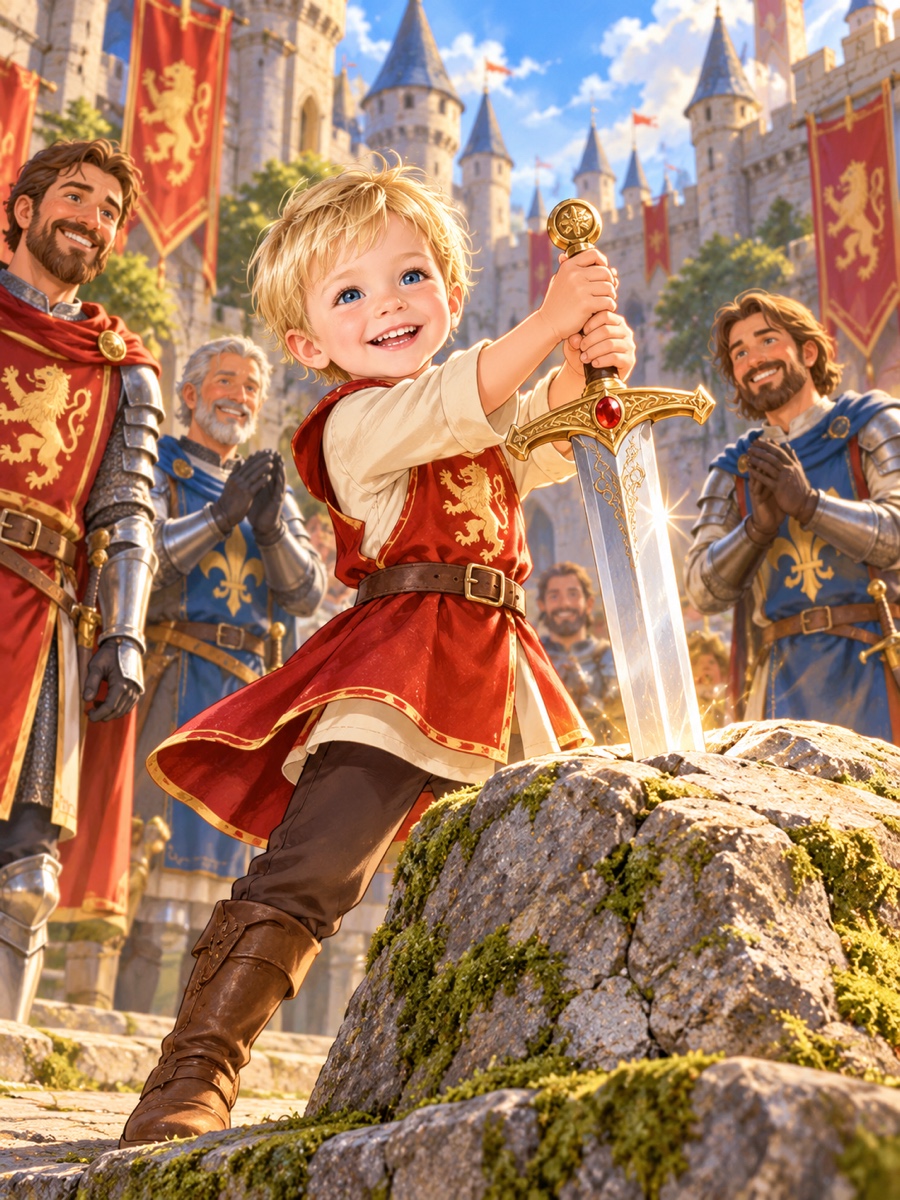
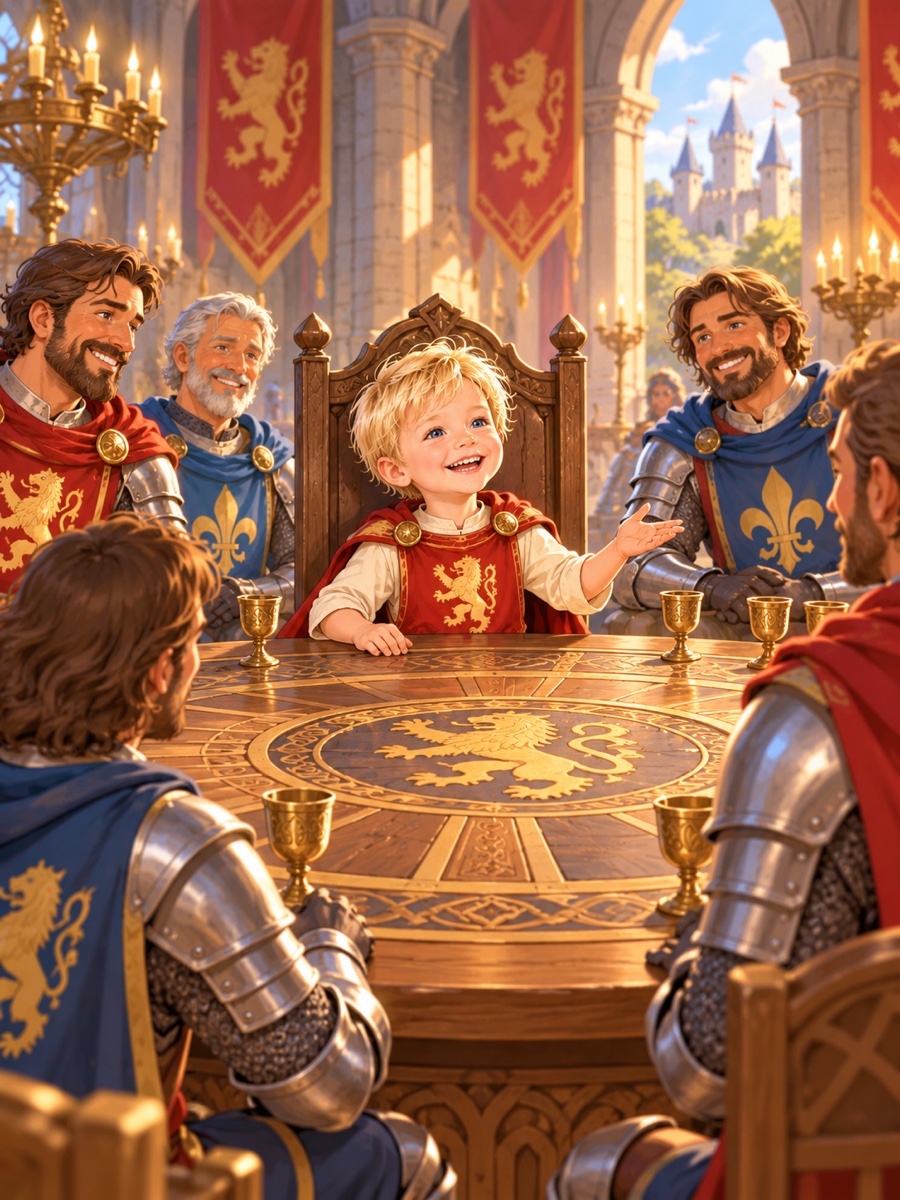
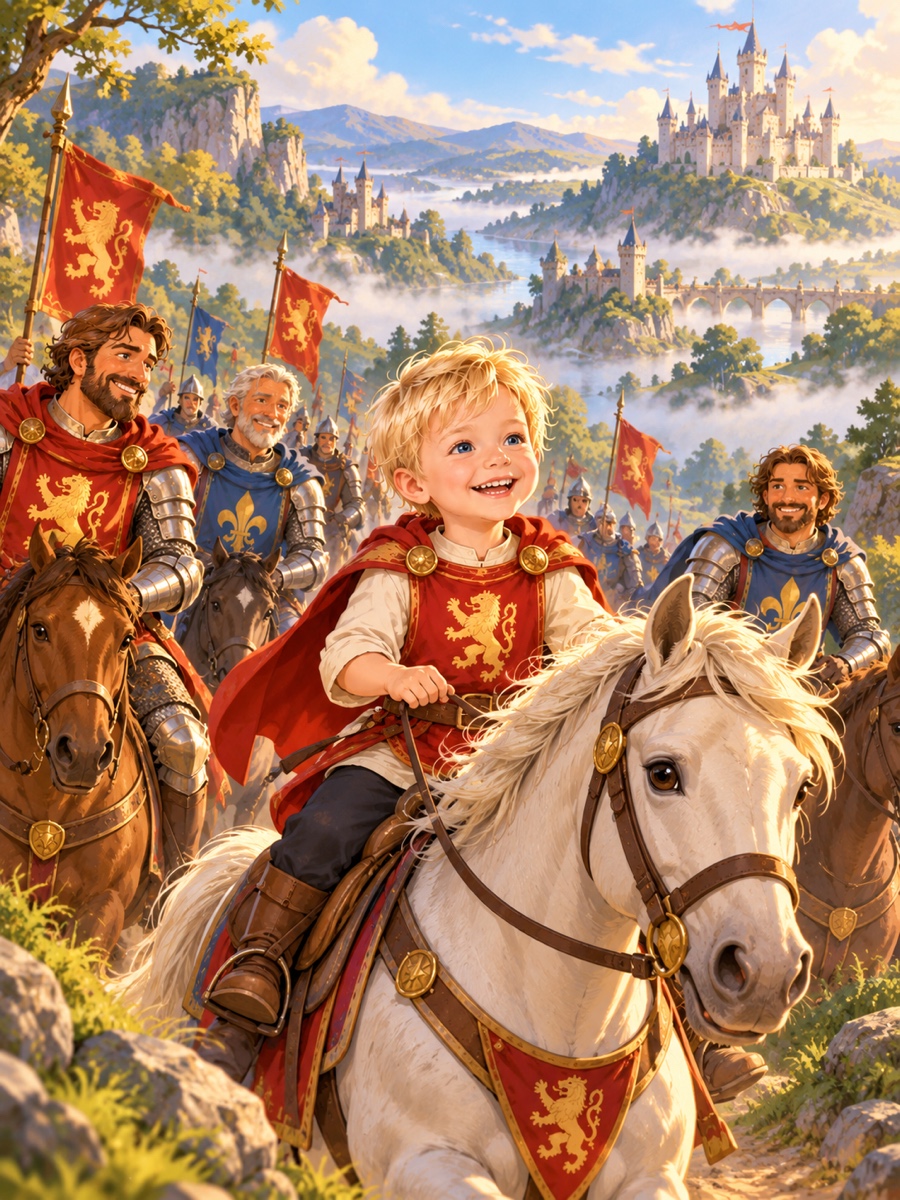
King Arthur and the Knights of the Round Table: the full story
Long ago, when Britain had no king and every lord wanted to be one, there was a boy called Arthur who worked in the stables of a knight named Sir Ector. Arthur did not know who his real father was. He mucked out the stalls, groomed the horses and fetched and carried for Sir Ector's son, Kay, who was a young knight himself and never let anybody forget it.
That winter a great tournament was held in London, and every knight in the land rode there to joust. On the morning of the tournament, Kay looked at his belt and turned pale.
"My sword!" he cried. "I've left it at the inn! Arthur, run back and fetch it, quickly!"
So Arthur ran all the way back through the busy streets. But the inn was locked, and everybody had gone to the tournament. The tournament field was loud and glittering with banners and trumpets, and the sword Arthur had been sent for was nowhere to be found.
Then, in a quiet churchyard, Arthur saw a great square stone, with an iron anvil on top of it. Driven deep into the anvil was a sword, and its hilt shone in the winter sun. There were words cut into the stone, but Arthur was in too much of a hurry to read them.
"Kay needs a sword," he thought. "I'll borrow this one and bring it back."
He took hold of the hilt and pulled. The sword slid out of the stone as easily as a spoon out of a pudding.
Arthur ran back to the tournament and gave it to Kay. Kay took one look at it and went very quiet. He knew that sword. Everybody knew it. For the words on the stone said: WHOEVER PULLS THIS SWORD FROM THIS STONE IS THE RIGHTFUL KING OF ALL BRITAIN. Grown knights, the strongest in the land, had tried it for years, and not one of them had been able to make it budge.
They all went back to the churchyard. Arthur put the sword back in the stone, and one by one the knights tried to pull it out. They heaved and strained until their faces were red, but the sword did not move. Then Arthur stepped forward, took hold of the hilt, and drew it out again as easily as before. The sword was called Excalibur.
An old man with a long white beard stepped out of the crowd. It was Merlin, the wise enchanter. "This is Arthur, the true son of the old king," he said, "and he is your king now."
So Arthur, the stable boy, was crowned in front of the whole kingdom, in a crown that was plainly several sizes too big for him.
Not everybody was pleased. Half the knights would not take an order from a stable boy, and they said so to his face. "What does he know about ruling a kingdom?" they grumbled.
Arthur did not shout at them, and he did not send them away. Instead he asked his carpenters to build a table. It was a round table, so big that it filled the great hall of his castle at Camelot, with no head and no foot. Then he invited all the bravest knights of the land to come and sit at it.
"At this table," said Arthur, "nobody sits higher than anybody else. Not even me. Here, everybody is heard."
The knights came, one by one, and sat down around the Round Table, and the grumbling slowly stopped.
Soon there was work for them to do. Messengers came from the north, where a fearsome giant was frightening the villages, stamping on fences and scaring the sheep. Arthur rode out with his knights, and they found the giant sitting on a hillside, sulking.
Arthur did not draw his sword. He climbed the hill and asked the giant what was wrong. It turned out that the giant had a terrible thorn in his foot, and it hurt so much that he stamped about all day. Arthur's knights pulled the thorn out between them, and the giant was so grateful that he spent the rest of the summer helping the villagers mend their fences.
Then two of the best knights at the Round Table fell out over a strip of land, and they would not even stay in the same room as each other. Arthur listened to the first knight, and then he listened to the second, and he did not know what to do. So, instead of pretending that he did, he asked for help. He asked Merlin, and he asked the farmers who worked the land, and he asked the other knights.
In the end they found the answer together. The strip of land was shared between the two knights, and a fair line was drawn down the middle of it, and the two knights shook hands.
"A king doesn't have to know everything," said Arthur afterwards. "He has to know when to ask."
That night every knight at the Round Table swore the same oath: to protect those who needed protecting, to listen, and to tell the truth. And Arthur stood up and swore it first.
Year after year Arthur ruled wisely with his knights. The fields were worked again, the roads were safe to travel, and Camelot became a quiet, happy place, and people far and wide were proud to say they came from there.
At last, when the sword had done everything it was meant to do, Arthur rode to the shore of a still, silver lake. He threw Excalibur far out over the water. And before it touched the surface, an arm in shimmering white rose out of the lake and caught it by the hilt. It held the sword up high and turned it three times in the light. Then it drew it gently down beneath the water, and the lake was still again.
The sword is there still, they say, waiting until it is needed once more.
Parts for your family
This tale has no parts of its own: everyone you add joins the story as themselves, beside the hero.