Key takeaways
- Ages 1–2: short, recognition is the whole point. Put a parent in the book.
- Ages 3–4: familiar fairy tales, because knowing the plot makes the surprise of being in it land.
- Ages 5–6: longer adventures, and a sibling or best friend as a second hero.
- Ages 7–10: let them choose the story and style, or write it together.
A two-year-old and a seven-year-old want completely different things from a book with themselves in it. The two-year-old wants to point at their own face. The seven-year-old wants to be the one who outwits the pirates, and would quite like to decide what the pirates look like.
Use these ages as starting points. Read the particular story first and follow your child’s interests, reading experience and response to tense scenes.
This is a rough guide, stage by stage. Children don’t read the age bands, so move up or down as you know yours.
One and two: finding themselves
For some toddlers, a simple familiar scene is enough. What matters is the moment of recognition, and saying their name out loud next to a picture of them. Recognising a photograph is different from recognising a spoken name: in a 1995 study by Mandel, Jusczyk and Pisoni, babies of about four and a half months already listened longer to their own name than to other names.
- Length: the shortest option. Six to ten pages is plenty.
- Story: something simple and repetitive, or a few sentences you write about their day.
- Who to add: a parent. Toddlers love seeing mum or dad on the page with them.
- How to read it: slowly, pointing. “Where’s Leo? There he is.”
Three and four: the fairy-tale years
This is when classic tales are at their best, because children know them well. They know the porridge will be too hot and the wolf will knock at the door, which means the joke of being inside the story works.
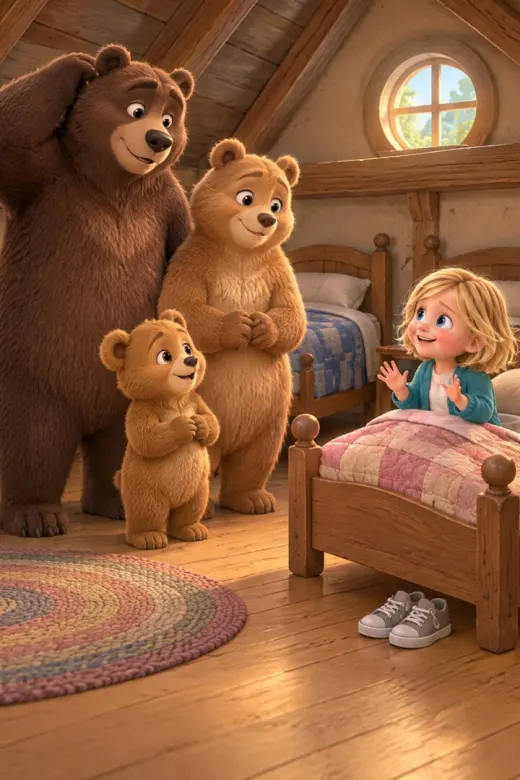
Goldilocks and the Three Bears
Too hot, too cold, just right
Make this book with your child →
The Three Little Pigs
Straw, sticks, and good solid brick
Make this book with your child →
Little Red Riding Hood
Through the woods to grandmother's house
Make this book with your child →
Hansel and Gretel
Pebbles, gingerbread and the way home
Make this book with your child →If you are giving the book from a grandparent, Little Red Riding Hood is the one: the grandmother part can be played by the actual grandmother. On I Am In the Story you also give the child’s age, and the text is written for it, so a three-year-old’s version uses shorter, simpler sentences than a six-year-old’s.
Five and six: adventure and a sidekick
Five-year-olds want things to happen on every page: flying, climbing, rescuing. And they care a great deal about who is with them. A book with the best friend or the big sister as a second hero is usually a bigger hit than one on their own.
Good picks are Peter Pan, Jack and the Beanstalk, Aladdin and Alice in Wonderland. In the Peter Pan sample, the child ends up rescuing the lost children from the pirates’ ship “quiet as a moonbeam”, which is exactly the kind of thing five-year-olds like to imagine doing.
Seven and eight: give them the controls
By seven, a book made for them is less exciting than a book made with them. Let them:
- choose the story, or write the idea with you in a few sentences,
- choose the illustration style (cartoon and photo-real are popular at this age; see the
styles guide
), - decide who else is in it.
Choose a longer book with more text per page. And let them read it to you. A book about themselves is a strong reason for a reluctant reader to have a go; we look at why in
why children love books about themselves
.
Nine and ten: keepsakes and jokes
At the top end of picture-book age, personalised books turn into something else: an in-joke with a friend, a record of a real event, or a present from the child to a younger sibling with both of them in it. Stories about a real match, a holiday or a new pet work well here.
A quick reference
| Age | Length | Story | Add someone? |
|---|---|---|---|
| 1–2 | Shortest | Simple, repetitive | A parent |
| 3–4 | Short to medium | A tale they know | A grandparent |
| 5–6 | Medium to long | Adventure | Sibling or best friend |
| 7–8 | Long | Adventure or their own idea | Whoever they choose |
| 9–10 | Long | Real events, in-jokes | Friends, siblings |
On
I Am In the Story
you set the length and the child’s age when you make the book, so the same tale can be a six-page toddler book or a longer adventure. There are
96 catalogue stories
to choose from, or you can write your own.
Source
Mandel, D. R., Jusczyk, P. W., & Pisoni, D. B. (1995). Infants’ recognition of the sound patterns of their own names. Psychological Science, 6(5), 314–317. DOI 10.1111/j.1467-9280.1995.tb00517.x.
Frequently asked questions
Is a personalised book suitable for a baby?
As a keepsake and for reading together, yes. Look at a picture or two and follow your baby’s interest.
Which personalised book is best for a 4-year-old?
A classic tale they already know. At four they understand the story well enough to find it funny that they are the one in the red cloak.
Is an 8-year-old too old for a personalised picture book?
Not if they have a say in it. Older children prefer adventures, longer books and stories they help write, often with a friend alongside them.
Pick a fairy tale, add your child
Classic stories children already know by name — each one retold with your child on every page.
Language:Deutsch Français Español Italiano Nederlands Svenska Dansk Norsk