Mission Control, Can You Hear Me? a personalized book with your child as the hero
Three Moon rocks, a silent radio, and room for another voice
Make this book · first 4 pages freeSee the example book
At planetarium space camp, our eager explorer dreams of the Moon but cannot get a tray of pretend rocks across the room with a teammate. During the simulator mission the training radio falls silent. A breath, a picture checklist and a carefully checked headset connection help the child find a voice from mission control. The crew brings its samples home together, with feet still firmly on Earth.
What your child learns
Small lessons inside the story, to talk about together after reading.
Stopping to ask instead of talking over each other
When the tray tips and the foam rocks roll away, our hero puts it down, asks the teammate where to stand and waits for the answer. Working together starts with listening.
A calm breath and a checklist
When the radio goes quiet, our hero freezes for a moment, then breathes out and follows the picture checklist step by step until mission control answers. A plan helps when we feel stuck.
Sharing the praise with your teammate
When the instructor praises the mission, our hero names what the teammate did too. A mission, like a game, belongs to everyone who helped.

See a finished book
Isla: Mission Control, Can You Hear Me?
A finished story. The child in it, Isla, is AI-generated — not a real child. Your own book stays private and is never published.
Illustrated (Picture style) · Low (Illustration strength) · Luminous drawing (Illustration look)
Watch Isla’s story as a video
The same book, read aloud page by page with music and subtitles.
Pages from the story
Pages from the story
Illustrations from this story. Your book is drawn with your own child as the hero, in this story's colours.
Mission Control, Can You Hear Me?: the full story
Quinn had packed an imaginary suitcase for the Moon. It contained a sandwich, a torch and a very patient toy rabbit. At breakfast, Quinn asked whether the Moon had a front door. By the time the family reached the planetarium, there were seventeen more questions waiting. Today was space camp. Perhaps some answers lived under that enormous silver dome.
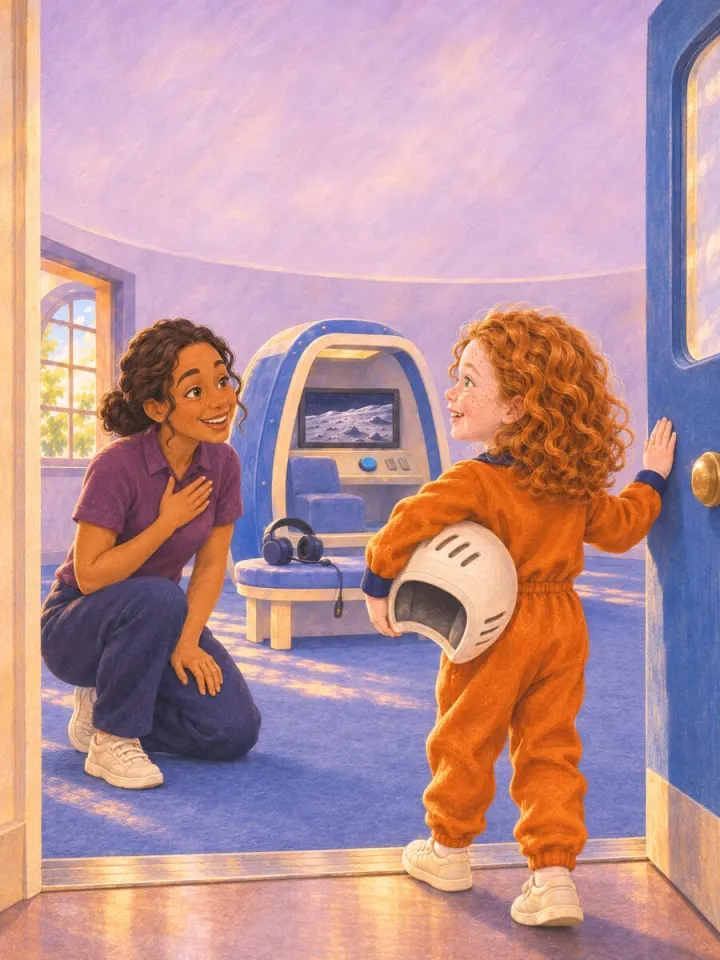
Inside, Quinn put on an orange camp coverall. A cratered Moon model stood beside a blue capsule with an open doorway. “Our simulator,” said the instructor. “A place to practise a pretend mission. It stays on this floor.” Quinn knelt beside the Moon and pointed to a round hollow. Going there would be wonderful. Pretending to go there would be a very good beginning.
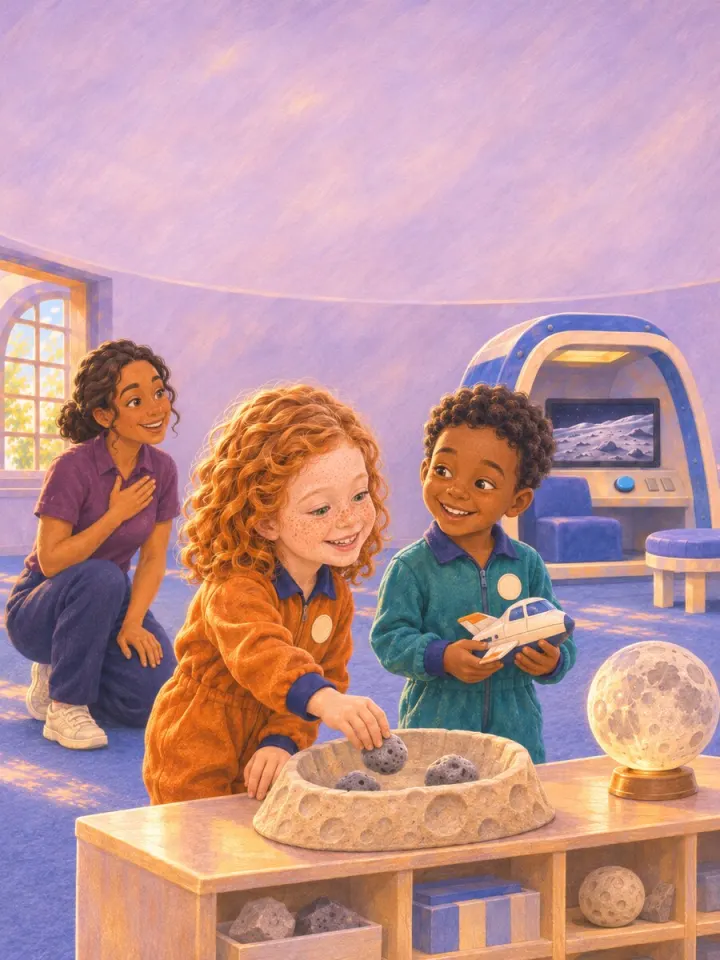
First came a task with a teammate called Kit. They each held one handle of a shallow tray containing three soft foam rocks. They had to carry it across a padded mat. “This way!” said Quinn. “Wait, turn!” said Kit at exactly the same moment. Quinn stepped; Kit stopped. The tray tilted. Three pretend Moon rocks rolled gently onto the floor.
Quinn sat back on their heels. Even an imaginary space mission was going wrong, and they had not reached the capsule. Their cheeks felt hot. Kit looked at the empty tray. “I couldn't hear what you wanted.” Quinn had not heard Kit either. Both children had been trying to be the loudest voice in the room.
“Let's put it down first,” Quinn said. They collected the rocks. This time Quinn asked Kit where to stand, then waited for the answer. Together they counted a slow three before lifting. The tray stayed level all the way across the mat. Quinn discovered that waiting could be part of doing something, even when their feet wanted to hurry.
During the briefing, the instructor brought out a costume helmet with an open face. “This is for dressing up. A real spacewalk helmet is part of a suit that keeps pressure around an astronaut and provides oxygen to breathe.” Quinn tried the prop briefly, then returned it to the shelf. For the indoor mission, a comfortable headset would be enough.
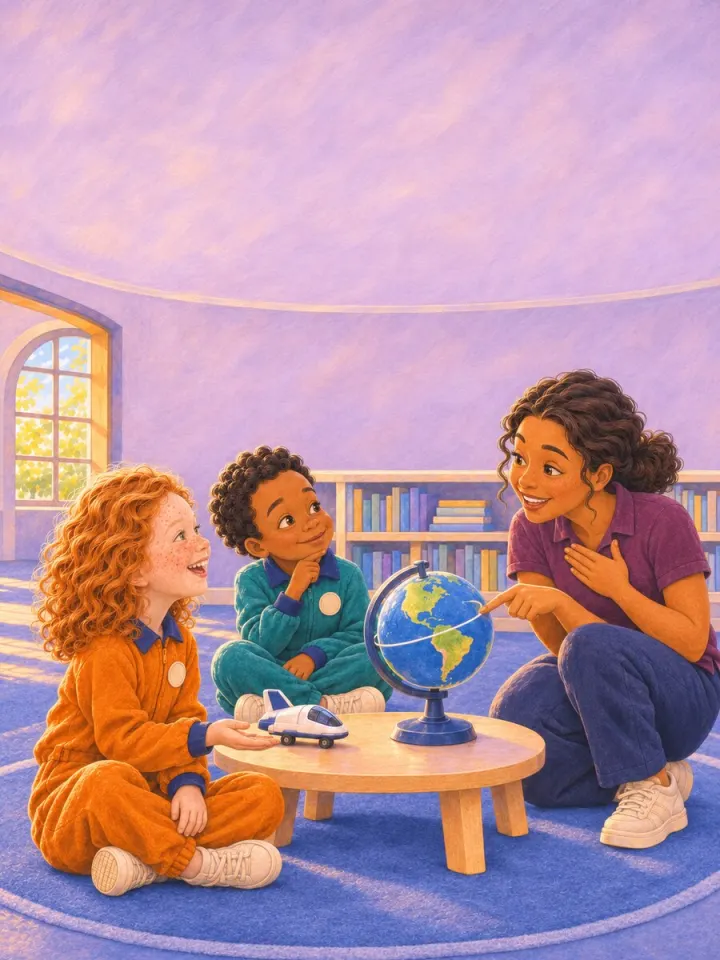
At a globe, Kit asked why astronauts floated. The instructor moved a toy spacecraft around Earth. “In orbit, the spacecraft and the people inside are falling around Earth together. Gravity is still pulling them.” Quinn imagined the toy rabbit floating beside a sandwich. Here in the classroom, though, shoes, sandwiches and rabbits would stay down. The simulator could pretend many things, but it could not make gravity disappear.
Next came a picture checklist. An ear meant pause and listen. A plug meant check the headset connection. A blue circle meant press the call button, speak and wait for a reply. These were the instructions for their camp game. If the radio stayed quiet, they should raise a hand for the instructor. Quinn traced each picture with one finger instead of rushing to the last.
Soon both children were seated in the open-sided capsule. The instructor checked that they were comfortable, then went to the mission-control desk just outside. “Three, two, one!” everyone counted. A screen showed the Moon growing larger. There was no real launch; Quinn could still see the classroom floor. Even so, their tummy fizzed as if a small rocket lived inside it.
“Capsule, prepare to collect your samples,” said mission control. Then the instructor muted the game radio for a training puzzle. The voice vanished. Kit called, “Hello? Hello!” Quinn's hands hovered over the controls. Which button? Should they press all of them? For a moment, the silent headset seemed enormous, and every useful thought seemed far away.
Then Quinn saw the little ear on the card. They lowered their shoulders and breathed out. “One voice,” Quinn said softly. Kit stopped calling and held the checklist steady. Quinn followed the next picture. The headset plug was loose in the practice panel. Carefully, they pushed the safe little connector fully into its socket. There was no need to touch anything else.
Quinn pressed the blue call button. “Mission control, this is the capsule. Can you hear us?” Then they waited. A tiny pause stretched between the two children. The instructor restored the link. “We hear you clearly.” Quinn's mouth curved into a smile. “We hear you too!” Kit grinned. The room had not changed, but it suddenly felt much bigger and friendlier.
“Place your samples in the tray,” said mission control. Quinn repeated the instruction so Kit could confirm it. They took turns collecting the three foam rocks from the low sample box. Then came the tray again. Quinn looked at Kit before lifting. Kit nodded. Together they carried their cargo level to the return station, where the screen changed from grey Moon craters to blue Earth.
Mission complete. Outside the capsule, Quinn cradled the tray while the instructor knelt beside both children. “You slowed down, checked carefully and made room for each other,” the instructor said. Kit pointed at Quinn. “You found the loose plug.” Quinn pointed back. “You held the pictures. And waited.” Neither could have carried both handles alone. The praise belonged to their whole small crew.
Quinn looked up at the Moon model once more. The real Moon was still wonderfully far away. Their shoes were firmly on Earth, their rabbit was waiting at home, and their imaginary suitcase needed one addition. Alongside the sandwich and torch, Quinn would pack enough quiet to hear a friend.
Parts for your family
Add these people to the book and they play these parts, with their own faces. Anyone else you add joins the story as themselves, beside the hero.
- The Space-Camp Instructor — suits: Mother, Father, Grandmother, Grandfather, Aunt, Uncle, Someone else
- The Mission Teammate — suits: Brother or sister, Cousin, Friend