The Pied Piper of Hamelin a personalized book with your child as the hero
A promise made, a promise broken, and a tune that brings a town together.
When small grey rats nibble the grain in timbered Hamelin, a colourful piper offers to lead them away for a fair purse of coins. He keeps his word, but the mayor does not. Then music drifts over the town and the children follow it to a sunny hill. This gentle retelling follows a young helper who reminds the grown-ups that promises matter, and who helps everyone find their way home to a joyful welcome.
Also known as The Pied Piper or The Piper of Hamelin.
See a finished book
Arthur and the Piper of Hamelin
An example book. The child in it, Arthur, is AI-generated — not a real child. Your own book stays private and is never published.
Illustrated (Picture style) · Low (Illustration strength) · Luminous drawing (Illustration look)
Colour palette: warm timbered-town ochres, muted teal, russet and burgundy accents, soft meadow greens, sunny hilltop gold
Sample pages
Sample illustrations of this tale. Your book is drawn with your own child as the hero, in this story's colours.
The Pied Piper of Hamelin: the full story
Long ago, in the old town of Hamelin, tall timbered houses leaned over the cobbled streets like friendly neighbours. Bakers rolled out dough, carts rumbled to market, and every morning the square smelled of warm bread and fresh straw. It was a happy place, until the rats came.
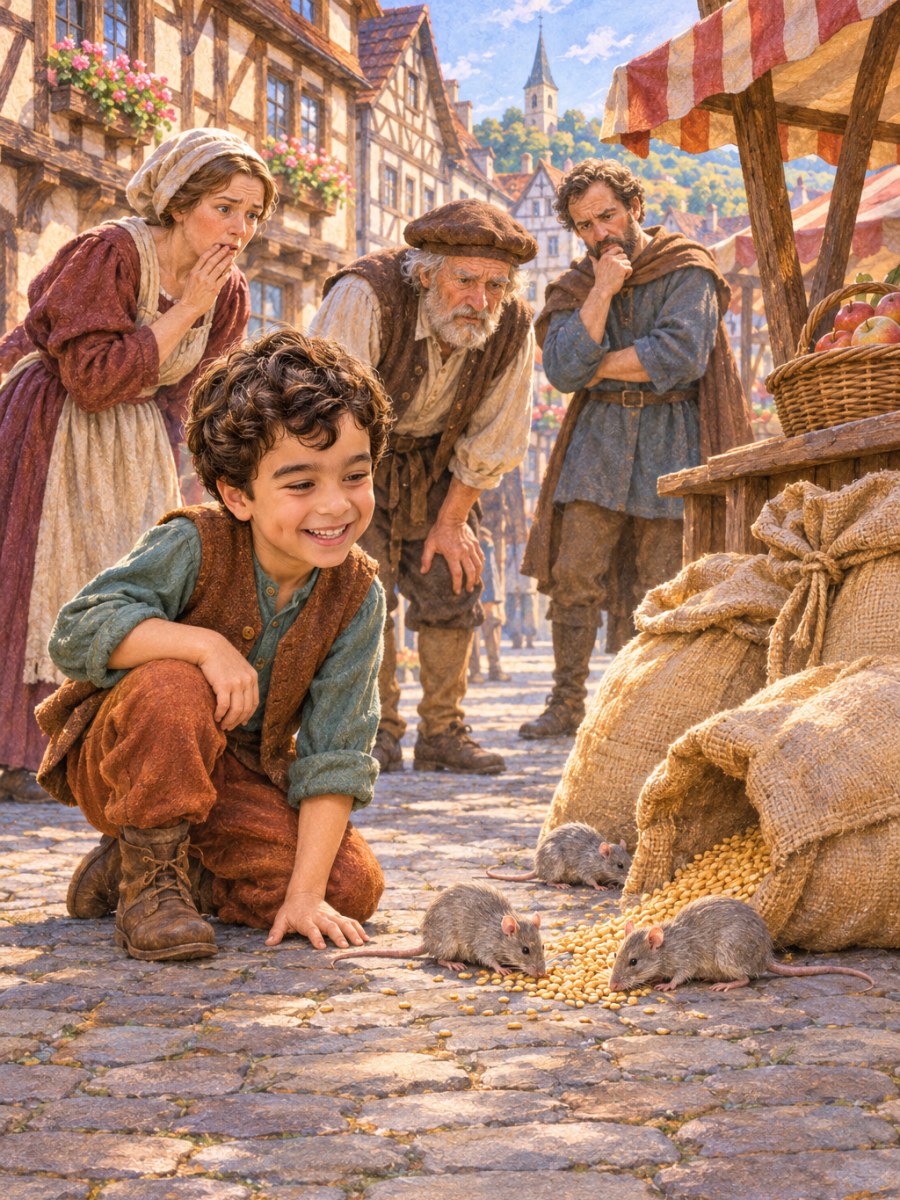
They were small grey rats, ordinary ones, but there were a great many of them, and they were hungry. They nibbled at the grain that spilled from the sacks in the market street. They nibbled the corners of the bakers' crates. The townsfolk shooed them away, but the rats only scurried off and came back again as soon as backs were turned.
"The grain store will be empty by winter," sighed the baker.
"We must do something," said the miller, wringing his floury hands.
A child of the town, who had been helping to stack the sacks, watched a little rat tug a kernel of grain across the stones. The child thought hard. Surely there was a kinder way than chasing them about.
The very next morning, a stranger walked into the square. He was a tall man with a short chestnut beard and a small brown cap with a feather in it. His long coat was stitched from patches of teal, rust and ochre, so that he looked like a walking autumn hedge. In his hand he carried a wooden flute.
"I am a piper," he said, in a calm and friendly voice. "For a fair payment, I can lead your rats away from Hamelin, and they will trouble you no more."
The child stepped forward at once. "May I help you?" the child asked. The piper smiled and nodded. "I would be glad of a helper," he said.
Together they went to the town hall, where the mayor stood on the steps in his burgundy robe, looking worried and important at once. "Lead them away," said the mayor, "and I will pay you a purse of coins." He held up a small, plain purse so everyone could see it. The piper bowed his head. "Then we have a promise," he said, and the child watched closely, for a promise is a serious thing.
The piper walked into the lane, lifted his flute and began to play. The tune was light and curious, like water running over stones. From behind barrels and under carts, the small grey rats came out. They did not rush or tumble. They formed a loose and orderly line and trotted after the music, tails swaying. The child walked behind with a kind neighbour, and the neighbour held the child's hand over the bumpy cobbles.
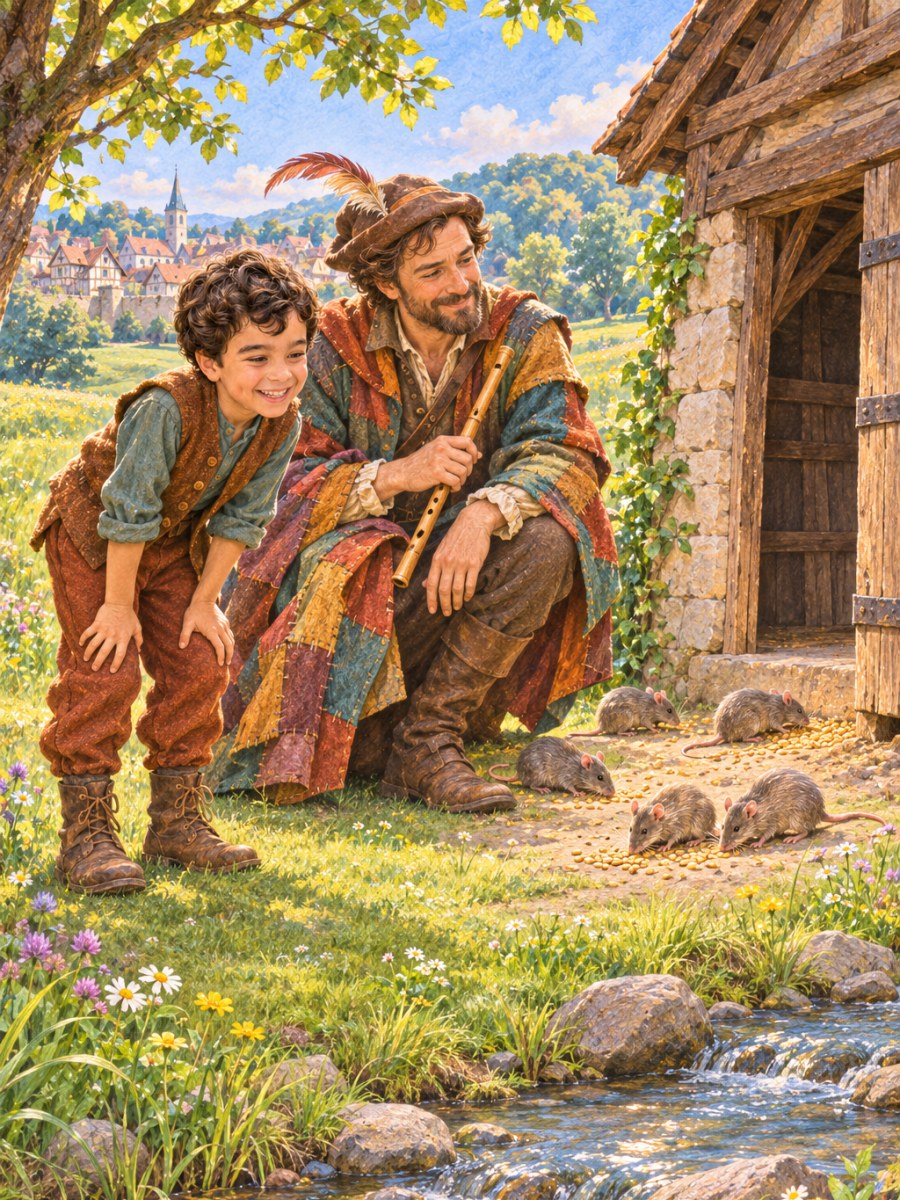
Through the town gate went the piper, and out into a bright meadow where the grass was long and the daisies nodded. There stood an old grain store, long empty and quiet, beside a shallow stream that chattered over its pebbles. The piper played the last notes of his tune, and the rats wandered happily into the grass beside the old store. There was plenty of room there, and plenty of seeds to find. They did not look back.
"They will be comfortable here," the piper told the child. "And Hamelin's grain will be safe." The child nodded, pleased, and the two of them walked back toward the town as the afternoon sun turned the rooftops gold.
But at the town hall, something had changed. The mayor had been thinking, and what he thought was this: the rats were gone, so why spend good coins? When the piper held out his hand, the mayor closed the little purse, tucked it under his arm and turned away.
"The rats left on their own, I daresay," he said. "Be glad of a good meal and go."
The piper said nothing at all. He lowered his flute and stood quietly, and he looked more disappointed than angry. The child felt a lump rise in the throat. A promise had been made, and now it was being forgotten.
The piper walked slowly through the square and out beyond the gate, and there on the sunny lane he lifted his flute again. This time the tune was warm and bright, like a summer fair. It drifted over the rooftops and in at the open windows. The children of Hamelin looked up from their games. They heard laughter in that music, and the promise of a pleasant afternoon. Nobody forced them. They chose to listen, and they chose to follow.
The child joined them, and soon a small group was walking up the lane, with two caregivers close behind to see that all stayed safe. Ahead rose a broad green hill, open to the sky, with grass as soft as a blanket. There was no cave and no dark place, only wildflowers and bees and a wide blue view.
When the parents of Hamelin noticed that the children were gone, they hurried to the gate in alarm. The mayor came too, red-faced and puffing. At the foot of the hill, the child met them.
"The children are safe," the child said clearly. "They are up there with the piper, listening to the music. But the piper kept his promise, and the town did not."
The mayor looked at the purse under his arm. He looked at the worried parents, and at the hill, where the music floated down like warm light. "I made a promise," he said slowly, "and I should have kept it."
"Then you can fix it," said the child, gently.
Up the hill they all climbed together. The children sat in the grass with their caregivers, tapping their feet and smiling. The piper played a last gentle tune, and then he lowered his flute and let the quiet settle.
The mayor bowed his head. "I am sorry, good piper," he said. "You did what you promised, and I did not." Then everyone walked back down the hill together, the children skipping between the grown-ups.
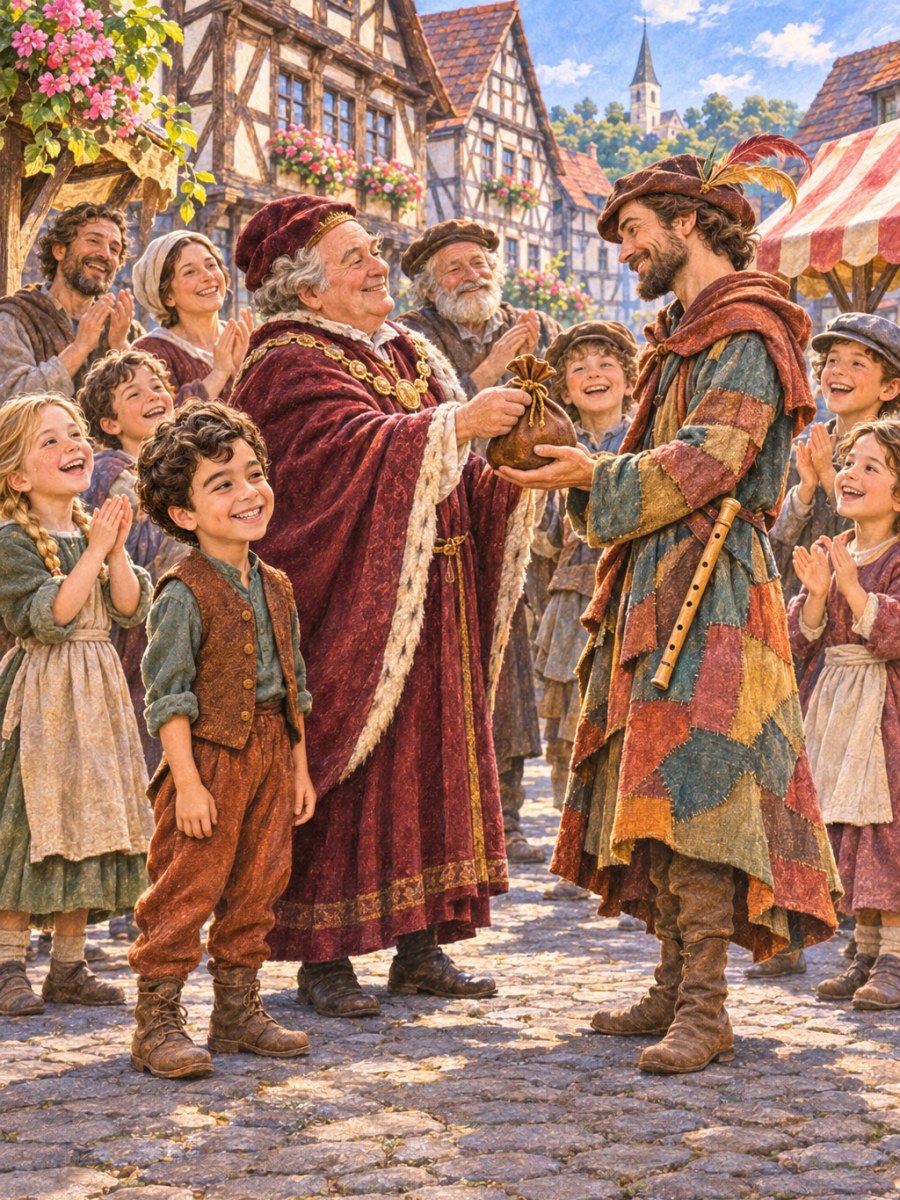
In the Hamelin market square, the mayor placed the agreed purse in the piper's hands. A cheer rose from the crowd, and the bakers brought warm bread and the children clapped in time as the piper played one more merry song. The town had learned that a promise is a promise, and the piper had found a home that welcomed him.
The rats lived on happily in their meadow, the grain stayed safe in Hamelin, and the child, who had helped to put everything right, went home with a full heart and a tune that would not leave the child's head.
Parts for your family
This tale has no parts of its own: everyone you add joins the story as themselves, beside the hero.
Digital book, 8 pages: $4.49 · or from $2.88 with a credit pack
🔒 Secure payment with Stripe · no subscription