The Karate Star with Quiet Strength a personalized book with your child as the hero
A bow, a brave choice, and a belt earned with control
Our eager karate star loves kicks and keeps forgetting the quiet part. Sensei shows how respect shapes every beginning and ending. When playground teasing brings hot cheeks and tight hands, the child discovers a different kind of strength: walking away and asking for help. A focused kata earns the next belt, but the proudest praise is for self-control.
What your child learns
Small lessons inside the story, to talk about together after reading.
Karate begins with respect
Our hero skips the bow and kicks straight away, and the sensei explains that karate begins and ends with respect: bowing, listening, leaving space and stopping when asked.
Calm is something we practise
Week after week our hero practises the basics: look before turning, plant the feet, stop when told. Calm and control grow with practice, like any skill.
Feeling angry, saying “stop” and getting help
When a classmate teases, our hero feels angry, notices tight hands, takes a breath, says “stop” and goes to the teacher. Anger is allowed, hitting is not, and asking for help is brave.
Strength you can use without a kick
The sensei praises our hero most for choosing safety at school. Karate’s quiet strength works outside the dojo too: with words, a breath and asking for help.
Pages from the story
Pages from the story
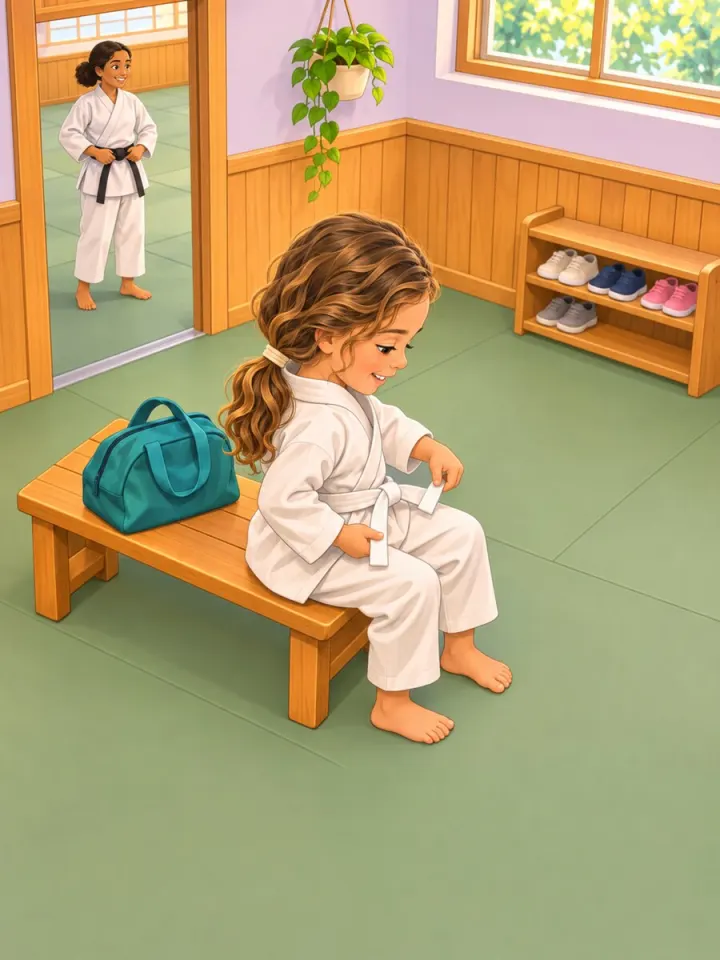
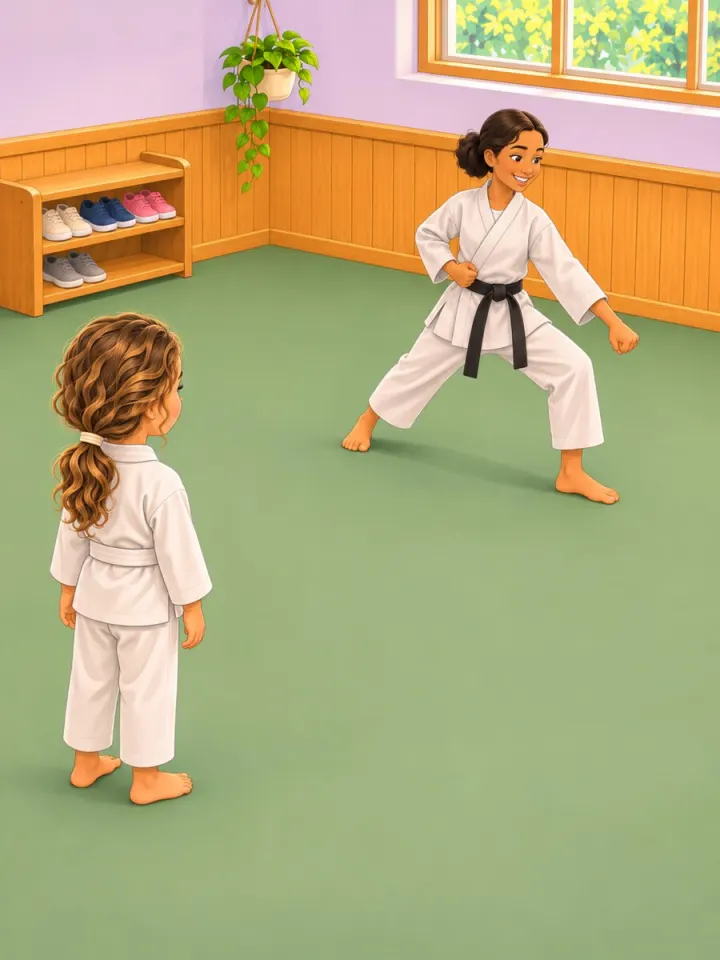
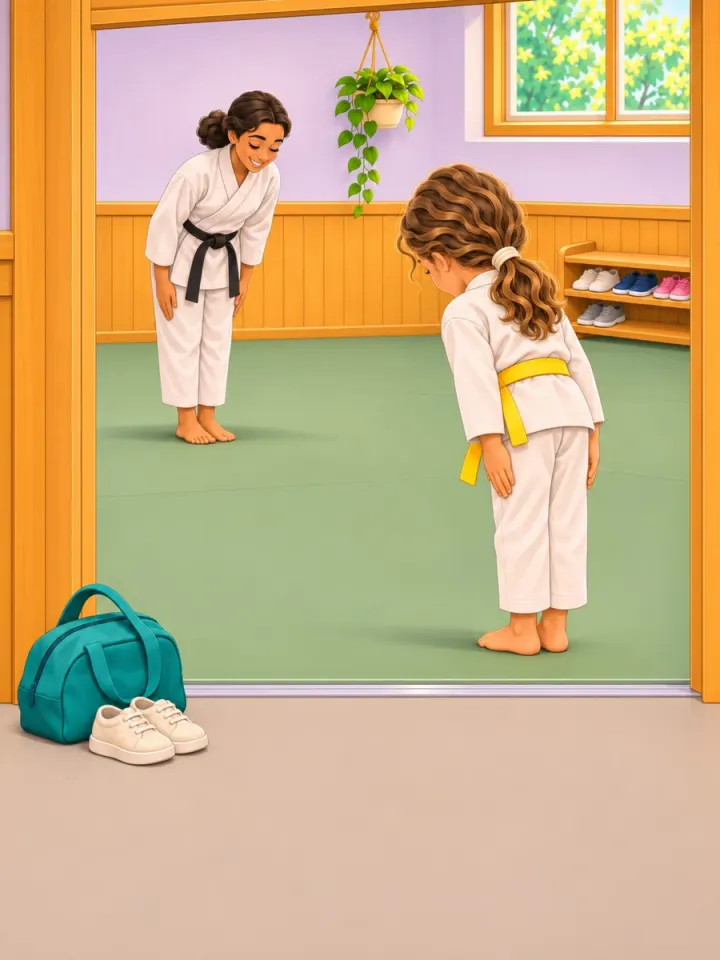
Illustrations from this story. Your book is drawn with your own child as the hero, in this story's colours.
The Karate Star with Quiet Strength: the full story
Riley could make the end of a white belt flick like a little flag. That was one excellent thing about karate. Another was the soft swish of a gi, the training uniform, when a foot moved through the air. Riley liked the kicks best. The waiting, listening and bowing seemed to take up rather a lot of kicking time.
At the community dojo, Riley put shoes on the rack and left a bracelet safely in the kit bag. Hair was tied back, the white belt was checked, and then came the warm-up. The children moved gently, woke up their ankles and found spaces where nobody could bump anybody else. Riley watched Sensei, their karate teacher, with one favourite move already waiting in a foot.
When it was time to begin the sequence, Riley went straight to that move. A low front kick, into empty space. Swish! Sensei had hardly started the opening bow. A quiet hand went up. Riley put the foot down. The room suddenly seemed enormous around two small bare feet.
“You remembered the kick,” Sensei said kindly. “What comes before it?” Riley looked at the white belt. Then at Sensei. “The bow.” They sat comfortably on their heels for a moment, hands resting on their thighs. Sensei sat nearby too. This was a conversation, not a telling-off.
“Karate begins and ends with respect,” Sensei explained. “We bow to thank the people and the place where we learn. We leave room. We listen. And we choose when to move and when to stop.” Riley wriggled one finger against a knee. “Even when I really want to kick?” “Especially then. Sometimes the strongest choice is the calmest one.”
Riley had thought of stillness as the bit between the real karate. Now it seemed stillness might be something to learn. Over the next few lessons, after warming up, Riley practised the familiar basics and the club's beginner kata. A kata was a set sequence of movements performed alone. There was no other person to hit. Its steps and turns belonged in a particular order.
Riley looked before turning, kept space around each movement and let the breath come naturally. When Sensei said “Yame,” meaning stop, Riley stopped. Both feet settled on the mat. Hands rested. Sometimes an extra wriggle escaped, but a small smile came too. Finishing a movement on purpose felt surprisingly satisfying. The quiet part was beginning to belong to Riley.
Then, one school breaktime, a child near the climbing frame asked about karate. Riley mentioned the coming belt test. “Only a white belt?” the child said. “That's nothing. Show us a kick, then.” There was a little laugh. Riley's cheeks grew hot. The courtyard seemed to shrink to that laugh and the child making it.
Riley knew a kick. A good one. For one sharp second, proving it seemed like the only possible answer. Fingers tightened beside the navy trousers. Then Riley felt the tightness. There it was: the moment before a movement. A breath went in and slowly out. One finger opened, then another. Both shoes stayed on the ground.
“Stop. I don't like that,” Riley said. The voice was small, but it was a voice. Riley turned and walked toward the teacher by the classroom door. Every ordinary walking step was a choice. The angry feeling came along too. Riley did not have to make it disappear before finding help.
The teacher bent to listen. Riley explained the teasing and the request for a kick. “Thank you for telling me,” the teacher said. “You can be angry. You don't have to hurt someone. I'll help make this stop.” The teacher stayed nearby and addressed what had happened. Sorting out the teasing was an adult's responsibility, not another test for Riley.
At the next karate lesson, Riley told Sensei about the playground. Sensei listened carefully. “You noticed your feeling, chose a safe action and asked for help. That is control.” Riley glanced down at the feet that had walked away. They had done something useful without leaving the ground. Still, there was a kata to practise and a turn that needed more attention.
Weeks passed. Some lessons felt smooth; others felt muddled. Riley kept returning, taking rests and asking questions. At last the club's next-belt test arrived. In this dojo, yellow came after white. Sensei had explained the club's beginner requirements, including the familiar basics, kata and respectful behaviour. Riley had worked on all of them. Now the white belt was tied neatly for one more important morning.
After the warm-up, Riley waited to be called. A flutter travelled around the tummy. When the clear practice space was ready, Riley stepped forward, brought the feet together and made a careful standing bow. There was time. Riley looked before the first turn, stepped into the taught stance and made the downward block with control. Another step. Another turn. Breath moving. Feet steady. The sequence reached its familiar ending. Riley stood, then bowed again.
Later, Sensei placed a soft yellow belt in Riley's hands. The requirements were met; the next belt was earned. “Your kata was focused,” Sensei said. “And what makes me proudest is the control you chose in the playground.” Riley smiled so widely that the little gap between the front teeth showed. The yellow belt lay warm across the lap. Tomorrow there would still be things to learn. But Riley already knew one wonderful thing: karate could help outside the dojo without a single kick.
Parts for your family
Add these people to the book and they play these parts, with their own faces. Anyone else you add joins the story as themselves, beside the hero.
- The Karate Sensei — suits: Mother, Father, Grandmother, Grandfather, Aunt, Uncle, Someone else
- The Trusted Teacher — suits: Mother, Father, Grandmother, Grandfather, Aunt, Uncle, Someone else