Clumsy Hans a personalized book with your child as the hero
A boy, a goat, a feather, a shoe and a handful of mud win a princess's friendship.
Two clever older brothers practise grand speeches to impress a quick-witted princess, but young Hans has no speech at all. He has a goat, a black feather, an old wooden shoe and a little mud. When the brothers freeze in the palace, Hans answers every question with cheerful, practical wit. Hans Christian Andersen's tale becomes a warm story about being yourself and finding a friend.
Also known as Clumsy Jack or Simple Hans.
Colour palette: moss green, rust orange, warm tan, soft palace gold, clay brown, sunny sky blue
Sample pages
Sample illustrations of this tale. Your book is drawn with your own child as the hero, in this story's colours.
Clumsy Hans: the full story
Once upon a time, in a farmhouse beside a quiet lane, there lived a family with three sons. The two older brothers were so clever that everyone in the village said they would go far. They had read every book on the shelf and could recite whole pages from memory. The youngest was called Hans, and people sometimes called him Clumsy Hans, because he was not one for long speeches. He liked to look at things carefully, and he had a way of saying exactly what he meant.
One morning news came that the princess of the nearby palace wanted company. She was bright and quick, and she was tired of visitors who only bowed and said grand things. She would be glad of anyone who could answer her questions well, and she would keep that person close as her friend and storyteller.
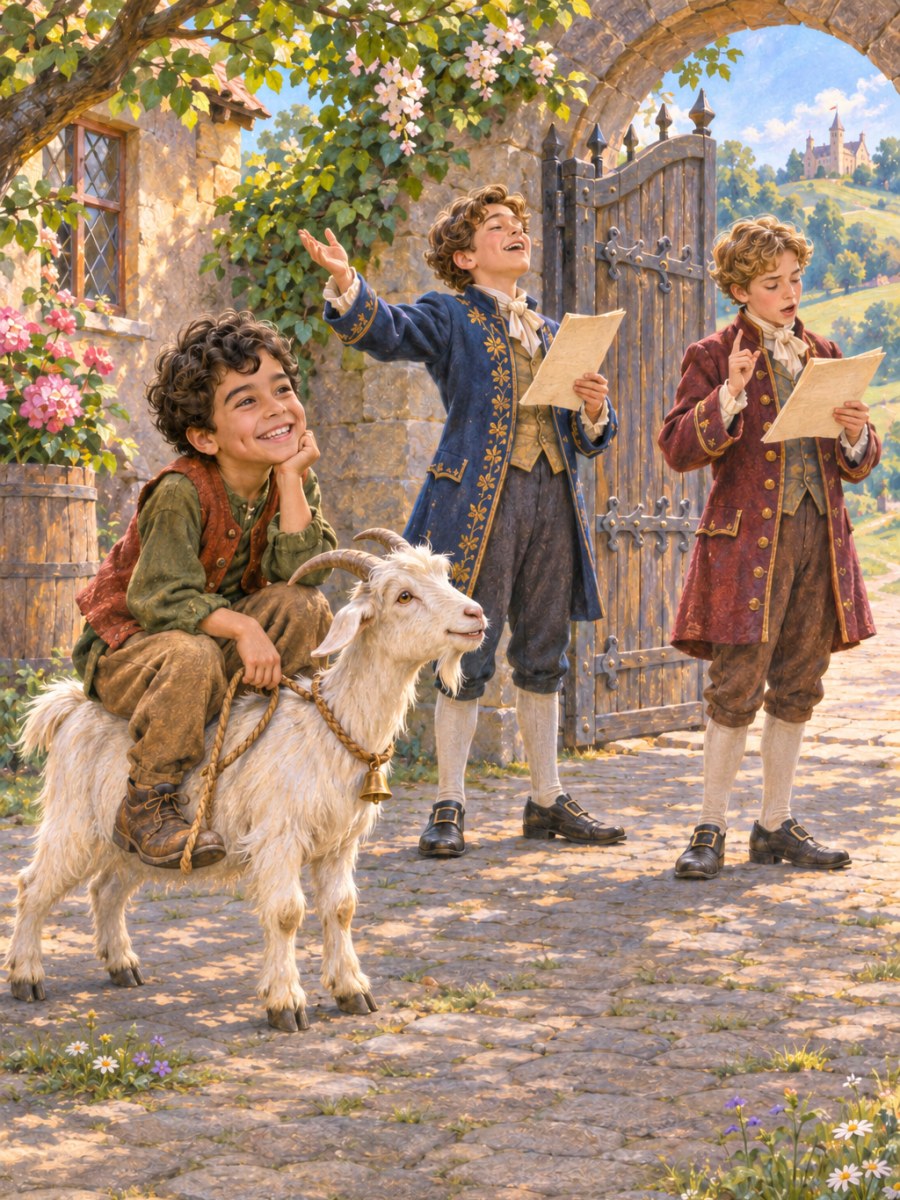
The older brothers were delighted. They stood by the wooden gate and practised their speeches until the hens grew bored. One recited every poem he knew. The other listed all the important things in the world, in alphabetical order, and waved his arm to make them sound grander. Hans sat on the gate and listened, swinging his shoes.
"Are you going too?" the eldest asked, with a little laugh.
"I think I will," said Hans. "I have never seen a palace."
"You have no speech," said the second brother. "You will only embarrass us."
"Then I shall say what comes into my head," said Hans, and nobody could argue with that.
The brothers hurried ahead along the lane, repeating their words under their breath. Hans did not hurry. He fetched the small sturdy goat from the yard, took the rope lead, and walked beside her. The goat trotted along, pleased with the sunshine and the smell of the hedges. Hans did not need a grand horse. He had company, and he thought that was better.
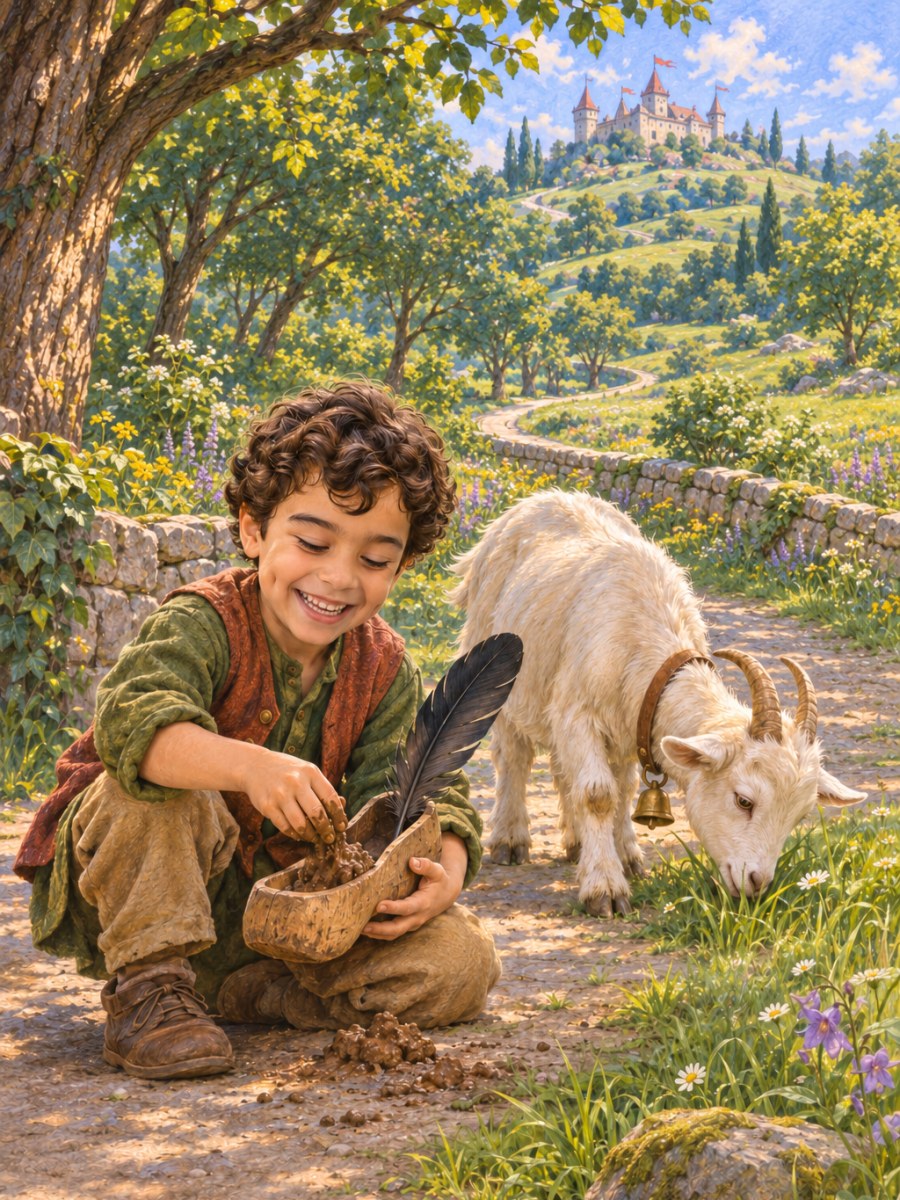
As they walked, Hans noticed something shining in the grass by the hedgerow. It was a large black feather, glossy as a wet stone, dropped by a crow who had flown on. Hans picked it up and turned it in the light.
"That might be useful," he said, and tucked it carefully into his waistcoat.
A little further on, half hidden under a dock leaf, he found an old wooden shoe, worn smooth by many walks. It had a hole in the heel, but the shape was good and deep.
"That might be useful too," said Hans, and carried it under his arm. The goat sniffed it and seemed to agree.
Where the lane dipped beside a damp bank, the ground turned to soft clay. Hans knelt down and scooped a little of the sticky mud into the wooden shoe, simply because it felt like the right thing to do. The goat nosed along the grass beside him, munching thoughtfully. Hans wiped his hands on the grass and set off again, with a feather, a shoe full of mud and a goat. He thought it a very respectable collection.
At last the palace rose before them, with tall windows full of light. The brothers were already inside, standing on the tiled floor of the great hall. The princess sat on a modest throne, watching them with her chin on her hand. Courtiers stood about the edges of the room, trying to look as if they were not listening.
The eldest brother stepped forward, opened his mouth and said nothing at all. The grand words he had practised so carefully had flown out of his head. The second brother tried, and his mind was just as empty. They stood there, red in the face, and the princess raised her eyebrows.
"Is that all?" she asked. "Is nobody here able to talk?"
"I can," said Hans, coming in with the goat waiting politely at the door.
The princess looked at the feather and the shoe. "And what have you brought?"
Hans held them up. "A crow's feather, which I found on the road, and an old wooden shoe. I thought they might be useful."
"Useful for what?" asked the princess, leaning forward with interest.
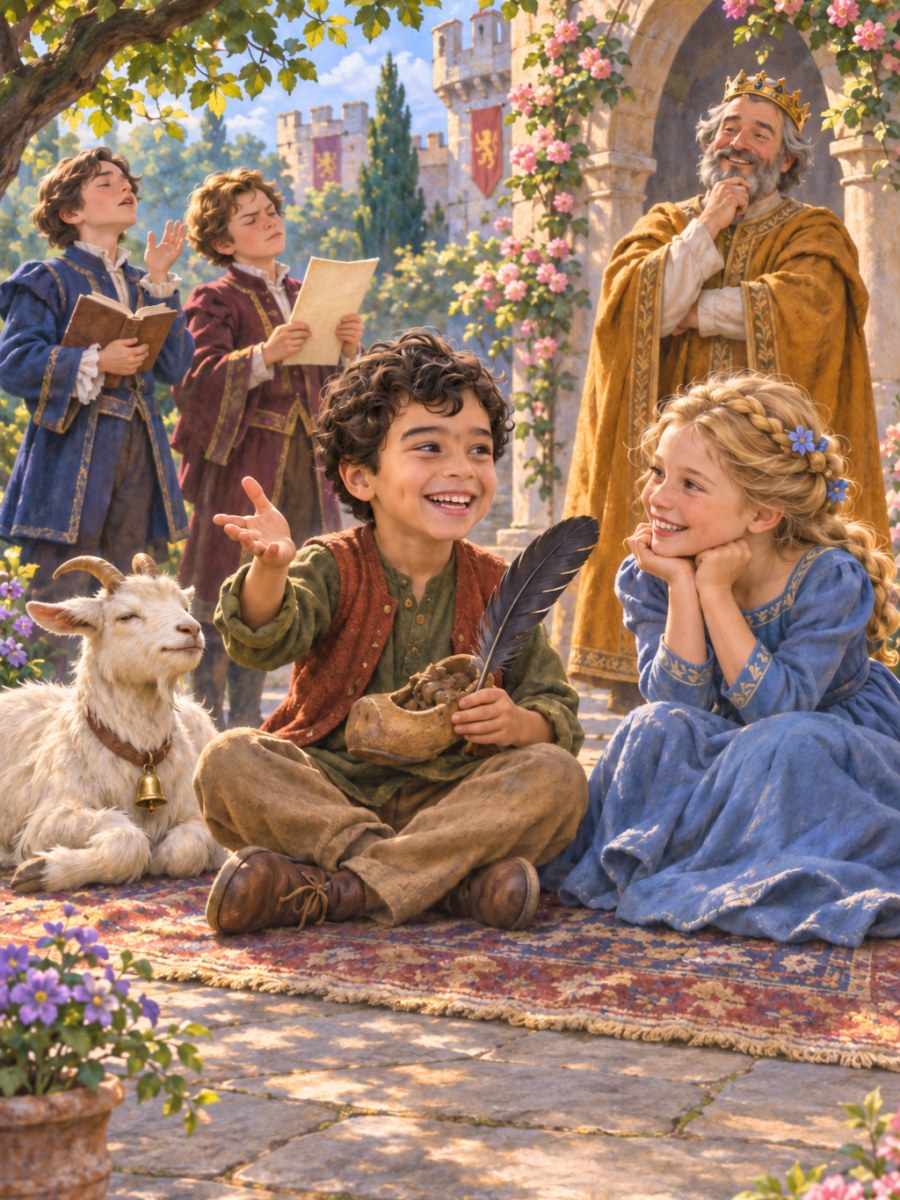
"For cooking, of course," said Hans, quite seriously. "The shoe is the pot, and the feather is the spoon to stir it with. It is not much of a kitchen, but I have cooked worse dinners with less."
The princess blinked. Then she smiled, because it was a real answer, and she had not heard a real answer all day.
"And what goes into the pot?" she asked.
Hans tipped the shoe so she could see the clay inside. "A little mud, to start. Every good stew needs something to build on. You can add the rest when you are hungry."
The princess laughed out loud, and the courtiers laughed too, kindly, because it was impossible not to. Even the brothers managed a shaky smile.
"You are the first person today who has made me laugh," said the princess. "Will you stay and tell me stories? I would like a friend who sees ordinary things in an interesting way."
"I would like that," said Hans. "As long as the goat can stay too."
So it was agreed. The goat settled in the sunny courtyard to nibble at the grass between the flagstones, and Hans sat beside the princess on a stone bench and began to tell her about a feather, a shoe and a walk along a lane. Nobody called him Clumsy after that, or if they did, they said it fondly.
Parts for your family
Add these people to the book and they play these parts, with their own faces. Anyone else you add joins the story as themselves, beside the hero.
- The Princess — suits: Friend, Brother or sister, Aunt
Digital book, 8 pages: $4.49 · or from $2.88 with a credit pack
🔒 Secure payment with Stripe · no subscription