The Rainy-Day Space Rocket a personalized book with your child as the hero
A big box, a home-made planet chart and a journey across the solar system
Make this book · first 4 pages freeSee the example book
Rain has spoiled the trip to the park, but a giant cardboard box is waiting. With a family grown-up, our young space explorer builds a rocket, draws a careful chart of the Sun and the eight planets and counts down to lift-off. In a big imagination journey they wave at the blazing Sun from far away, land on dusty red Mars, find the way through the asteroid belt with their own chart and marvel at giant Jupiter and Saturn's icy rings, before splashdown back on the living-room floor.
What your child learns
Small lessons inside the story, to talk about together after reading.
A rainy day can become an adventure
The park trip is cancelled and our hero is bored, until a big empty box becomes a rocket. Imagination can turn an ordinary afternoon into a journey.
The planets in order from the Sun
Our hero draws the Sun and the eight planets in the right order: Mercury, Venus, Earth, Mars, Jupiter, Saturn, Uranus and Neptune, with the rocky asteroid belt between Mars and Jupiter.
A plan you made yourself can show the way
Lost among the space rocks, our hero doesn’t give up, unrolls the home-made chart and steers on towards Jupiter. A careful plan of your own helps when you feel lost.

See a finished book
Oliver: The Rainy-Day Space Rocket
A finished story. The child in it, Oliver, is AI-generated — not a real child. Your own book stays private and is never published.
Illustrated (Picture style) · Low (Illustration strength) · Luminous drawing (Illustration look)
Pages from the story
Pages from the story
Illustrations from this story. Your book is drawn with your own child as the hero, in this story's colours.
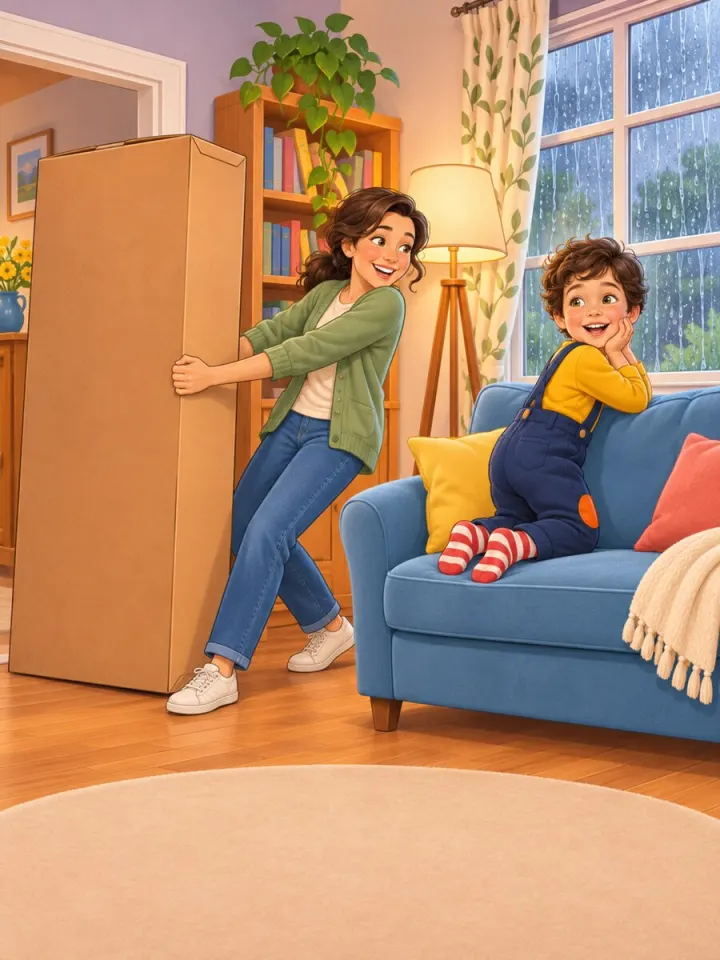
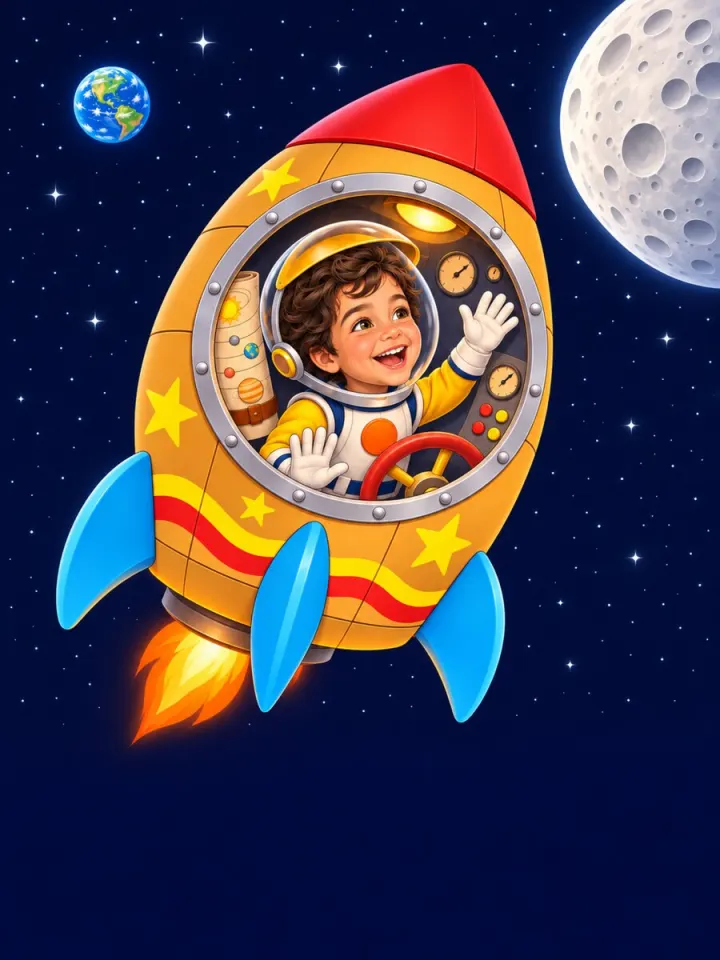
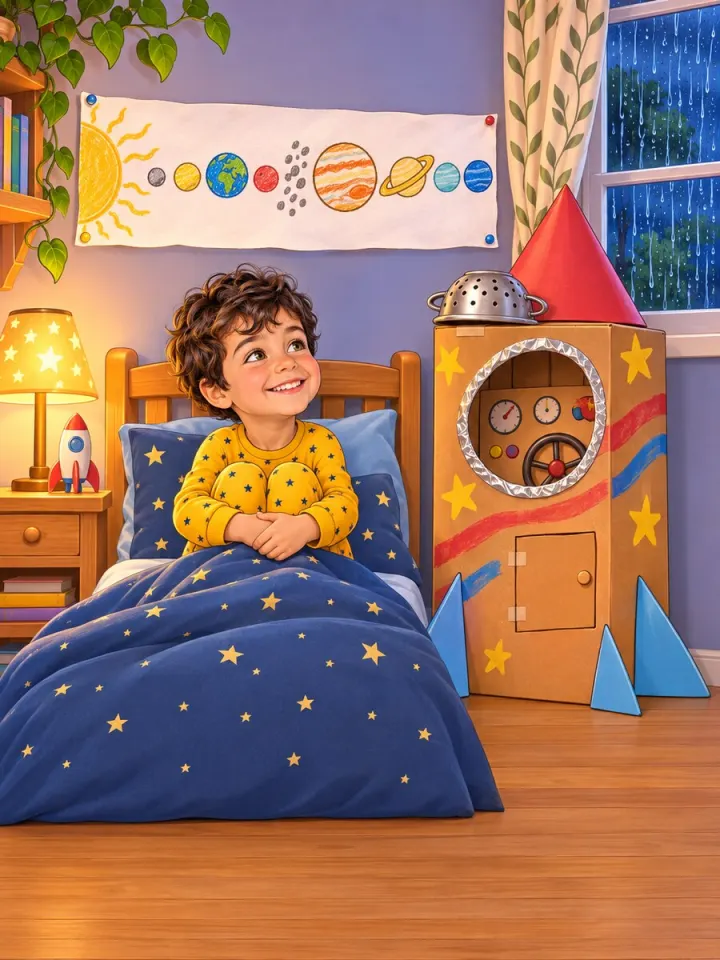
The Rainy-Day Space Rocket: the full story
Rain drummed on the window all morning. It drummed on the roof, it gurgled in the drainpipe and it filled the garden with puddles. The trip to the park was cancelled, and Jasper sat on the sofa with both hands under Jasper's chin, watching the drops race each other down the glass.
"There is nothing to do," said Jasper.
Just then there was a bump and a scrape in the hall. Mum came in backwards, dragging the biggest cardboard box Jasper had ever seen. The new fridge had arrived in it that week. Now it was empty, and it was taller than Jasper.
"What could a box this big be?" asked Mum.
Jasper looked at the box. The box seemed to look back. "A rocket," said Jasper. "A real space rocket."
They spread old newspaper on the floor. Mum used the scissors to cut a round window near the top and a door in the side, because scissors are a job for a grown-up. Jasper painted the box with careful strokes, drew dials and buttons and a big round steering wheel on the inside wall, and taped three paper fins to the bottom. Mum rolled a cone of red card for the nose. The last thing was the helmet. Jasper found the shiny kitchen colander and put it on. It was a little too big, and it was perfect.
"Every explorer needs a map," said Jasper. "Otherwise how do you find your way home?"
So at the kitchen table Jasper took a long sheet of paper and the crayon box. Jasper's little brother pulled himself onto the chair opposite and passed the crayons one by one, the yellow first. In the middle of the left-hand edge Jasper drew the Sun, big and blazing. "The Sun is a star," said Jasper. "And eight planets go round it."
Jasper counted them on the paper, saying each name out loud. Mercury, small and grey and closest to the Sun. Venus, wrapped in thick yellow clouds. Earth, blue and green, home. Mars, red. Then a scribbly band of little rocks. Then Jupiter, the biggest, with stripes. Saturn with its rings. Then Uranus and Neptune, far out and cold and blue. Mum taught them a rhyme to remember the order, and Jasper's brother tried to sing it and got the words all mixed up, and they both laughed.
Jasper rolled the chart up, tied it with a hair band and climbed into the rocket. The colander went on. Mum waved from the doorway.
"Five," said Jasper. "Four. Three. Two. One. Lift-off!"
And in Jasper's imagination, the box began to shake. It rumbled. It roared. The living room fell away, the rain clouds rushed past the round window, and the cardboard rocket became a real one, climbing out of the grey and into the dark. The colander was a real space helmet now, with a clear bubble at the front, and Jasper's clothes had become a white spacesuit, because there is no air to breathe in space. Below, the Earth curved away, blue and white and beautiful.
Far ahead, something blazed brighter than anything Jasper had ever seen. The Sun. "That is the hottest place of all," said Jasper, and lowered the golden visor. "Much too hot to visit." So Jasper waved from very far away. Near the Sun a little grey planet hurried along: Mercury. Then came Venus, hidden in thick yellow clouds, the hottest planet of them all. Jasper checked the chart. Exactly right.
Then the rocket turned outward, past the Earth, past the grey Moon, and on toward a small red dot that grew and grew. Mars! The rocket landed with a soft bump in red dust. Jasper climbed down, crouched and scooped up a gloveful. The dust was red because it was rusty, like an old bicycle left out in the rain. Rocks lay everywhere. Two tiny lumpy moons hung in the sky, and far away a huge old volcano rose higher than any mountain on Earth.
Jasper climbed back in and flew on. And then, all at once, there were rocks everywhere. Big ones, small ones, lumpy ones, tumbling slowly in the dark. Left, right, above, below. Which way was the way on? Jasper's tummy fluttered. The window was full of rocks and nothing looked like anything.
Jasper took a long breath. Then Jasper untied the hair band and unrolled the chart.
There was the Sun. There were Mercury and Venus and Earth and red Mars. And after Mars, the scribbly band of little rocks. "After Mars come the space rocks," said Jasper slowly, finger on the paper, "and then the biggest planet of all." Jasper looked up. Far beyond the tumbling rocks there was a soft striped glow. Carefully, slowly, steering round each rock, the rocket went toward it.
There it was. Jupiter, so huge it filled the whole window, with bands of cream and orange and brown, and a great red storm that was bigger than the whole Earth. Jasper pressed both gloves to the glass and laughed out loud. Further on, Saturn floated in its rings, and the rings sparkled, because they were made of millions of pieces of ice and rock. Far, far behind, home was a tiny blue dot.
"Time to go home," said Jasper, and turned the steering wheel.
Splashdown! The rocket landed with a bump on the living-room rug. The rain was still drumming on the window. Mum and Jasper's little brother were on the sofa.
"Where have you been?" asked Mum.
"Everywhere," said Jasper, and unrolled the chart, and taped it to the side of the rocket. Then, pointing to each one, Jasper named every planet in order, from Mercury to Neptune, and told them about the rusty dust, the storm on Jupiter and the icy rings. Jasper's little brother listened with his mouth open.
Mum hugged Jasper tight. "You drew your own map," she said, "and it found the way. You are a real space explorer."
Parts for your family
Add these people to the book and they play these parts, with their own faces. Anyone else you add joins the story as themselves, beside the hero.
- The Family Grown-up — suits: Mother, Father, Grandmother, Grandfather, Aunt, Uncle, Someone else
- The Little Sibling — suits: Brother or sister, Cousin, Friend