The Superhero Who Noticed a personalized book with your child as the hero
A homemade cape, a quiet mew and a power hiding in plain sight
Make this book · first 4 pages freeSee the example book
A homemade cape ought to come with a whoosh. When it does not, our would-be superhero nearly misses the neighbour struggling with shopping. A light bag, a kitten's tiny mew, a place in a game and a sibling's sadness reveal a different power: noticing, asking and being kind. By bedtime, the family knows a real superhero has been through town.
What your child learns
Small lessons inside the story, to talk about together after reading.
Noticing others is a real superpower
Nothing magical happens when our hero puts on the cape, so the hero starts noticing people instead: a neighbour with bags, a lost kitten, a quiet child. Kindness begins with paying attention.
Asking before helping
Our hero asks the neighbour before carrying the light bread bag, and asks the little sibling before folding a new paper boat. Help feels best when the other person wants it.
Inviting someone to play
Our hero invites a quiet child into the chalk-river game, waits through the silence and uses the new child’s bridge idea. Making room for someone is a big kindness.
Listening when someone is sad
When the little sibling is sad about a squashed boat, our hero stops being silly and listens first. Sometimes the kindest thing is not to cheer someone up straight away.
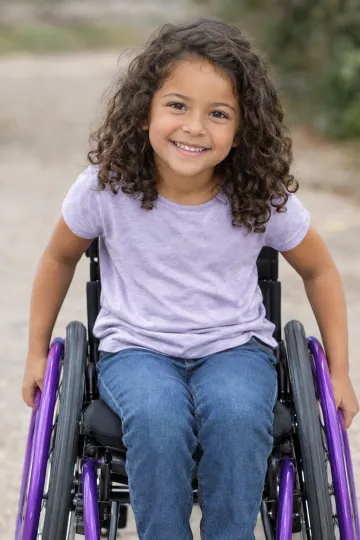
See a finished book
Maya: The Superhero Who Noticed
A finished story. The child in it, Maya, is AI-generated — not a real child. Your own book stays private and is never published.
Illustrated (Picture style) · Low (Illustration strength) · Luminous drawing (Illustration look)
Pages from the story
Pages from the story
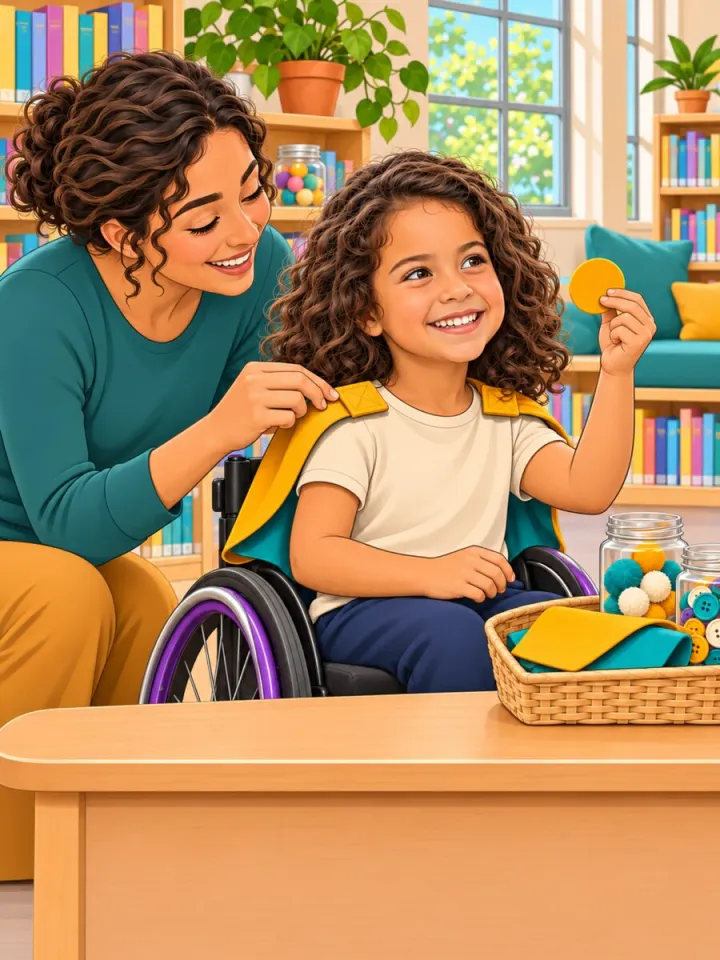
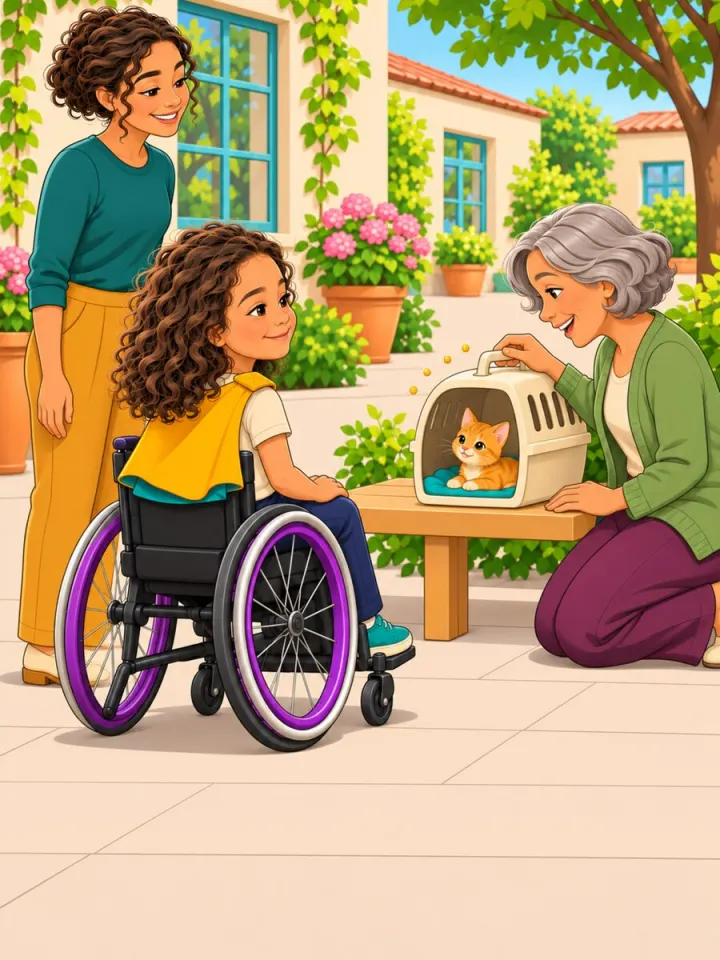
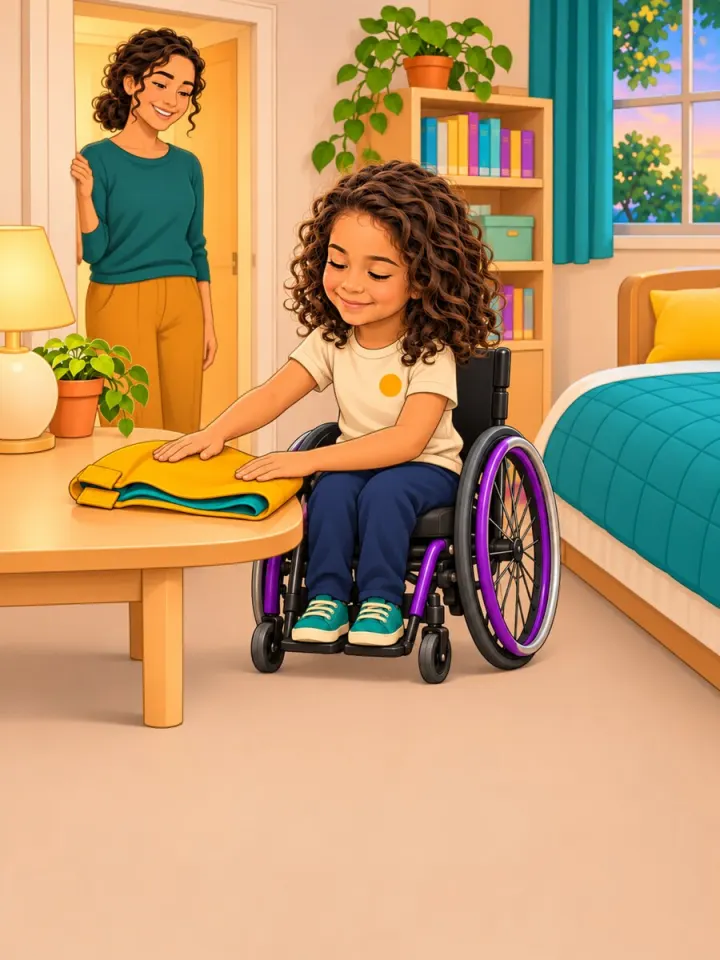
Illustrations from this story. Your book is drawn with your own child as the hero, in this story's colours.
The Superhero Who Noticed: the full story
Maya had made a cape the colour of honey. Mum helped fasten it with little fabric tabs at the shoulders. Its teal lining flashed when Maya turned, and its short hem stayed well clear of the purple wheels. On the cream T-shirt was one round felt badge. No letters. No lightning bolt. Maya had not chosen a power yet.
“Flying,” Maya decided, raising a folded paper bird towards the courtyard sky. “Or lifting something enormous. A whole house, perhaps.” Mum smiled from the bench. “A house would be rather difficult to put down.” Maya pictured the roof wobbling, laughed and looked expectantly at the cape. Any moment now, there would surely be a whoosh.
Maya waited on the level paving. A leaf moved. A pigeon moved. The cape did nothing at all. Maya lowered the bird and stared at the ordinary fabric. It was a good cape. But without a power, what was the point? Then a paper bag rustled. Their familiar neighbour had stopped beside the gate, put down the shopping and rubbed one hand.
Maya almost looked away. A superhero ought to be watching for enormous things. But the neighbour picked up the bags, took three steps and stopped again. Maya rolled closer, Mum alongside. “Would you like some help?” The neighbour looked inside a small bag. “Could you bring this bread to my garden table? It's very light.”
The little bag rested flat on Maya's lap, leaving both hands free for the wheel rims. Mum carried the heavy shopping. Along the smooth path they went, slowly enough to keep the bread safe. At the table the neighbour sighed happily. “Thank you. That saved my sore fingers.” Maya imagined two golden flecks beside the bag. Not real sparks. Just how the thank-you felt.
Then the neighbour glanced towards the shrub. “Now, where has that kitten gone?” The ginger kitten usually slept in a sunny flowerpot, but the pot was empty. Maya looked up at a branch. If only flying were possible! They could search every rooftop. A very small sound interrupted the very big idea. Mew. Maya stopped moving. There it was again, almost underneath the rustling leaves.
Maya tilted their head and listened. A cream muzzle peeped from beneath the low shrub beside the path. “There!” Maya pointed without reaching in. “Mum, beside the pot!” Mum called the neighbour, who gently settled the kitten in its carrier. Maya stayed back and gave it space. The neighbour checked the carrier door. More golden flecks danced in Maya's imagination. This time, being quiet had helped.
After lunch the courtyard became a river. The river was blue chalk, the islands were big circles, and Maya was in charge of imagining boats. Two children wanted a waterfall. Maya wanted an enormous whirlpool. They were about to begin when Maya noticed another child standing outside the chalk line, rubbing a little piece of chalk between finger and thumb.
“Do you want to play?” Maya asked. No answer. The whirlpool was waiting. Maya nearly turned back to it, then remembered the tiny mew: something quiet could still matter. “You could make an island,” Maya offered, “or help me think of a bridge.” They left a space and waited. At last the child looked up. “A bridge with room for a dragon?”
“A friendly one,” Maya said. The new child drew a splendid looping bridge. Soon everybody was deciding where the dragon could keep its slippers. Maya laughed until their cheeks hurt. The imagined flecks shone around the place they had left open. The best part of the game had come from somebody Maya might have missed.
At home a different sound waited: a sniff from the low table. Maya's younger sibling sat beside a squashed blue paper boat. A cushion had landed on it. “Captain Crumple to the rescue!” Maya announced in a booming superhero voice. The sniff became a sob. “It isn't funny.” Maya's smile faded. The voice had been meant to help, but it had not helped at all.
Maya wanted to make everything cheerful immediately. Instead they stopped the performance and came beside the table. “You liked that boat.” Their sibling nodded. Maya rested a hand nearby. “Would you like company?” Another nod. They sat together, with Mum close by. Maya did not promise that the boat would become perfect again. For a while, neither child said anything. The quiet felt warm instead of empty.
After a little while Maya asked, “Shall we make another, or keep sitting?” Their sibling chose teal paper. They folded slowly, taking turns to press each crease. The first boat stayed on the table too. When the new boat opened, one end stuck up like a nose. Their sibling made a tiny snorting sound. Then both children laughed. Maya imagined the softest golden flecks of the whole day.
At bedtime the cape lay folded on a chair. Maya rested under the teal quilt; the purple-wheeled chair was parked beside the bed. “You brought bread, heard a kitten, made room in a game and listened,” Mum said. Their sibling added, “You waited for me.” Maya touched the quilt. None of those things had needed a whoosh.
“I think this town has a real superhero,” Mum said. Maya smiled. The cape was still ordinary fabric. The power had been in looking, asking and doing something kind. “Tomorrow,” Maya whispered, “I'll see who needs me.” Then a sleepy thought followed. “And I'll ask what they need first.”
Parts for your family
Add these people to the book and they play these parts, with their own faces. Anyone else you add joins the story as themselves, beside the hero.
- The Nearby Grown-up — suits: Mother, Father, Grandmother, Grandfather, Aunt, Uncle, Someone else
- The Familiar Neighbour — suits: Grandmother, Grandfather, Aunt, Uncle, Someone else
- The Younger Sibling — suits: Brother or sister, Cousin, Friend