The Bridge-Builder Princess a personalized book with your child as the hero
A flooded path, three little models and one strong idea
Make this book · first 4 pages freeSee the example book
Our princess would rather build a marble run than try on a ball gown. When spring rain floods the path to the village market and the grown-ups cannot agree, she makes a model river in the castle courtyard. A twig rolls, a string sags, and then the roof of the great hall shows her a shape that never squashes. With the village carpenter doing the sawing and lifting, a small, safe bridge brings the whole village together again.
What your child learns
Small lessons inside the story, to talk about together after reading.
Asking people what they need
While the grown-ups argue, the princess asks everyone what a bridge must carry and draws their answers. Good ideas start with listening.
Every try teaches something
The round twig rolls and the string sags into the water. The princess laughs, frowns and learns something from each try, as the carpenter says every good builder does.
A triangle keeps its shape
The princess notices that the strong old roof beams are triangles: push a triangle and it keeps its shape. Looking closely at the world around you gives you ideas.
Staying well back from flood water
The princess stays on the dry bank beside the queen and behind the rope while the grown-ups saw and lift. Rushing water and heavy tools are for grown-ups.

See a finished book
Charlotte: The Bridge-Builder Princess
A finished story. The child in it, Charlotte, is AI-generated — not a real child. Your own book stays private and is never published.
Illustrated (Picture style) · Low (Illustration strength) · Luminous drawing (Illustration look)
Watch Charlotte’s story as a video
The same book, read aloud page by page with music and subtitles.
Pages from the story
Pages from the story
Illustrations from this story. Your book is drawn with your own child as the hero, in this story's colours.
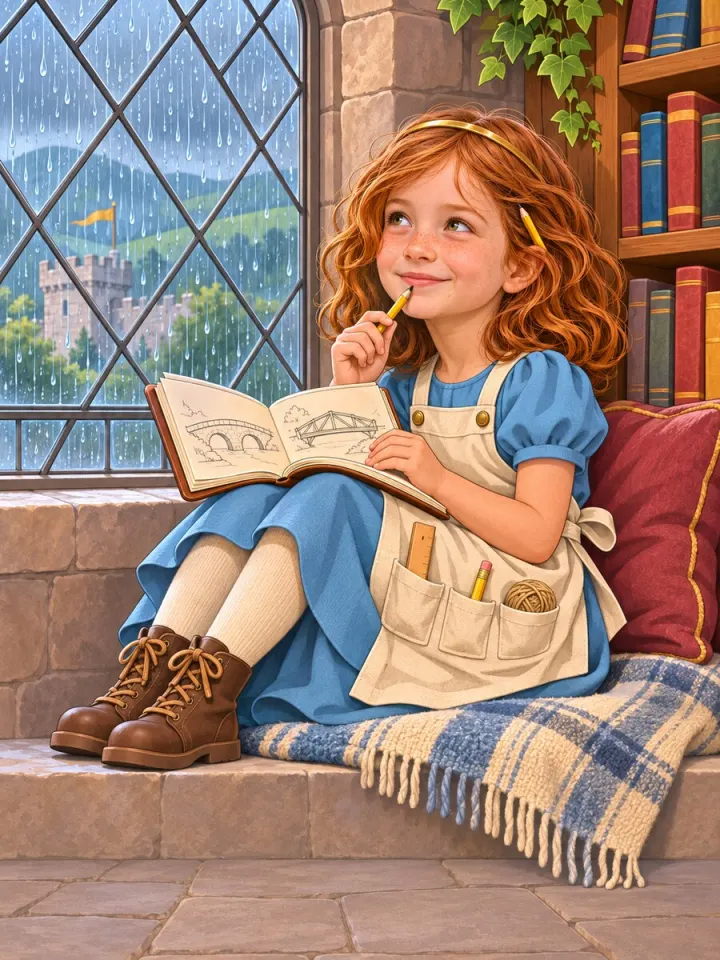
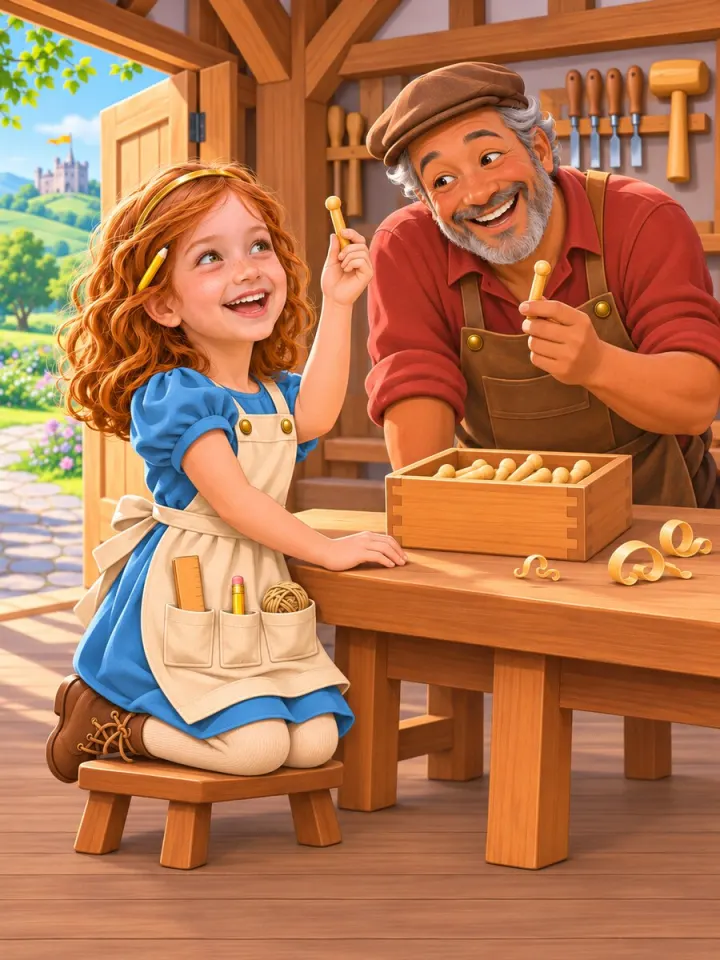
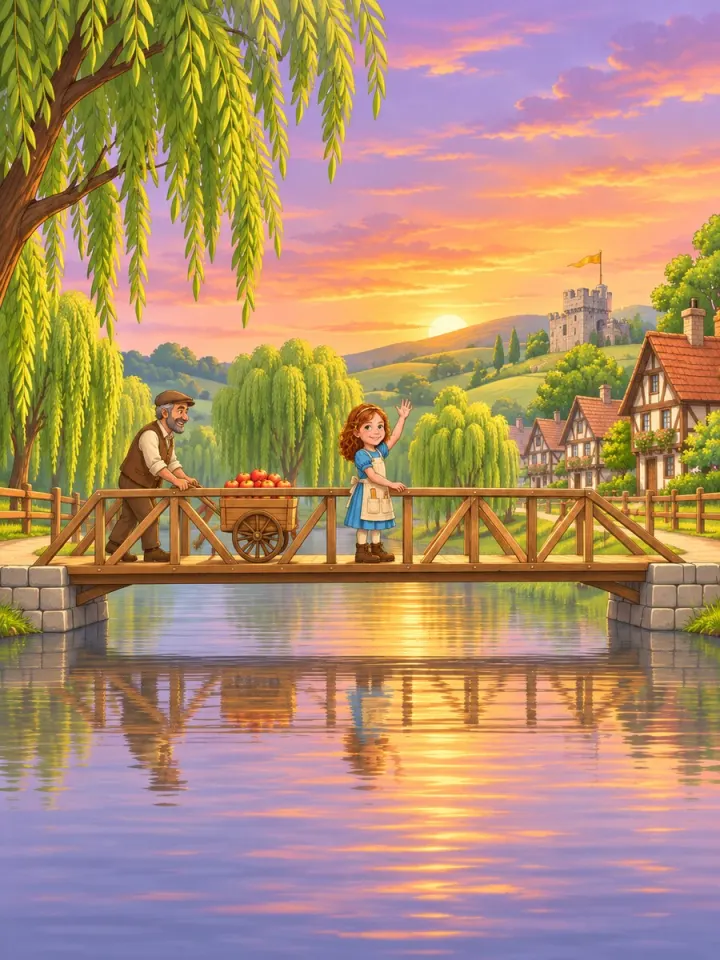
The Bridge-Builder Princess: the full story
Princess Hazel lived in a small kingdom of green hills, with a stone castle on one side of a little river and a timber village on the other. Every week the villagers crossed the river on a row of flat stepping stones to the market by the castle wall.
Hazel liked balls well enough. She liked gowns well enough too. But what she really loved was building. Her apron pockets held a little wooden ruler, a pencil stub and a ball of twine, and there was usually another pencil tucked behind her ear.
On the morning of a dress fitting, the queen found her on the playroom rug beside a tall marble run made from wooden offcuts. A marble rattled down the ramps and clicked into a cup at the bottom.
"The dressmaker is waiting," said the queen. Then she watched the marble go round once more and smiled. "Finish your track first."
That spring it rained for five whole days. When the sun came out, Hazel and the queen walked down to the river. The water was brown and fast and high. The stepping stones had disappeared. On the far bank the market baker stood with a round basket of bread and could not cross.
The grown-ups began to argue, not crossly, but loudly. "Build a wall!" said one. "Use a boat!" said another. "Just wait for summer," said a third. Nobody agreed with anybody.
Hazel held the queen's hand and stayed well back on the dry grass. Flood water is faster and colder than it looks, and she knew it. But she was thinking.
"What does a bridge have to do?" she asked.
The village carpenter, a patient grown-up in a leather tool apron, looked surprised. Then he started to count on his fingers. "It must carry the baker and her basket. It must carry a handcart full of apples. And it must stand higher than the water, even after a week of rain."
Hazel opened her pocket sketchbook and drew everything he said. The carpenter walked along the bank to the narrowest place, measuring with big steady steps, and called out the number. Hazel wrote that down too.
Back at the castle, she made a model river. The long stone water trough in the courtyard was perfect. She chose a little wooden toy to be the baker and laid a round twig across the water for a bridge.
The toy took one step. The twig rolled. Splash! The toy bobbed in the trough.
Hazel burst out laughing. "Round things roll!" she said, fishing the toy out. "A bridge needs a flat top, and it has to be held still at both ends."
Next she built two towers of wooden blocks, one at each end of the trough, and tied a piece of string between them, pulled as tight as she could. Then she laid a row of pebbles along the string, one by one, the way a row of people might walk across.
The string bent. It sagged in the middle, lower and lower, until the pebbles touched the water.
Hazel frowned and put her chin on her fist. Just then the carpenter came through the courtyard with a plank on his shoulder.
"Not working?" he asked.
"It sags," said Hazel.
"Then it has taught you something," said the carpenter. "A good builder learns something from every try."
That evening there was a supper in the great hall. Hazel wasn't very hungry. She leaned back in her chair and looked up at the ceiling, where the lamps glowed on the big old roof beams.
She sat up straight. The beams made triangles. Big triangles, small triangles, triangles leaning on triangles, all the way along the roof.
After supper Hazel tied three thin sticks into a triangle and pressed it as hard as she could. A square of sticks would have squashed flat. The triangle kept its shape. So she built a whole model bridge out of triangles, with a flat deck along the bottom, and tied every corner tightly with twine.
In the morning the grown-ups were back on the riverbank, still arguing. Hazel walked up and held out her model on both palms. Her knees were a little wobbly, but her voice was not.
"Please could we test this?"
The carpenter set the model across two flat stones. He put one pebble in the middle. Then two. Then a whole handful. Then a whole bucket. The little bridge did not bend.
Everyone went quiet.
"Triangles," said the carpenter slowly. "We can build this, bigger and safe."
For three days the grown-ups worked. The carpenter measured and sawed the timbers. His helpers lifted the heavy beams and knocked in the wooden pegs. Hazel stayed behind the rope line on the dry bank, because saws and heavy beams are grown-up work, but she held the plan and counted every triangle out loud.
"One more on the left!" she called, and the carpenter checked and nodded. She was right.
On the fourth morning the bridge was finished. It was small and wooden and strong, with a handrail on each side, and it stood well above the river. The carpenter tested it first, stamping in the middle. It didn't move an inch.
"Who should cross first?" asked the queen.
Hazel knew straight away. "The baker. She's been waiting all week."
So the baker stepped onto the bridge with her round bread basket, and walked all the way across, and the whole village cheered.
The queen knelt down and hugged Hazel tightly. "You asked good questions," she said. "You tested your ideas, and you didn't give up when they didn't work. That was clever. And you built it for everyone. That was kind."
That night the carpenter left a present by the castle door: a real carpenter's pencil, flat so it would never roll away. Hazel tucked it behind her ear. She was already thinking about the next thing to build.
Parts for your family
Add these people to the book and they play these parts, with their own faces. Anyone else you add joins the story as themselves, beside the hero.
- The Queen — suits: Mother, Grandmother, Aunt, Someone else
- The Village Carpenter — suits: Mother, Father, Grandmother, Grandfather, Aunt, Uncle, Someone else
- The Market Baker — suits: Grandmother, Grandfather, Someone else