The Dinosaur Secret in the Sand a personalized book with your child as the hero
A small brush uncovers a very big beginning
Make this book · first 4 pages freeSee the example book
Too small to see past the crowd at the T. rex display, our hero feels left out. A museum guide offers a soft brush and a practice dig. Patient strokes uncover a dinosaur egg replica, opening an imagined world of a friendly hatchling, footprints and feathers. Back in the museum, a careful explanation earns family praise and a junior palaeontologist badge.
What your child learns
Small lessons inside the story, to talk about together after reading.
Small, gentle brush strokes
In the sandpit our hero wants to pull out the curved edge, then chooses small gentle brush strokes and rests a tired wrist. Patience uncovers the egg without breaking it.
Knowing what is real and what is imagined
Our hero keeps the real egg model and the imagined baby dinosaur apart, and tells the family honestly what was found and what was invented. Imagining is wonderful, and so is being honest.
What fossils tell us about dinosaurs
Fossils are protected remains and traces of ancient life: some dinosaurs ate plants and others ate animals, footprints can become fossils, and some dinosaurs had feathers.
Small explorers make discoveries too
At first our hero thinks the museum is only for bigger people. A small discovery of your own can be as exciting as the biggest skeleton.
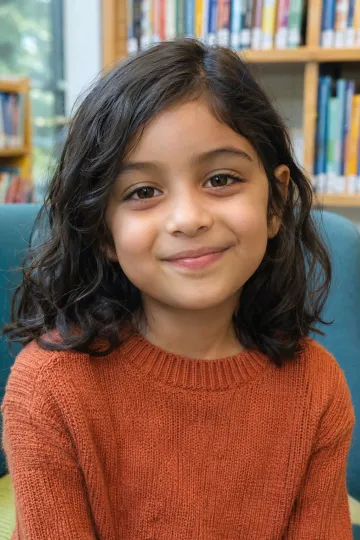
See a finished book
Florence: The Dinosaur Secret in the Sand
A finished story. The child in it, Florence, is AI-generated — not a real child. Your own book stays private and is never published.
Illustrated (Picture style) · Low (Illustration strength) · Luminous drawing (Illustration look)
Pages from the story
Pages from the story
Illustrations from this story. Your book is drawn with your own child as the hero, in this story's colours.
The Dinosaur Secret in the Sand: the full story
Hollis had come to the natural history museum to meet the biggest dinosaur. Not a living one, of course. A T. rex skeleton stood in the great hall, its tail stretching behind it like a long bony question. Hollis could see the tail. And somebody's coat. And somebody else's elbow. Everybody seemed tall enough to see the skull except Hollis.
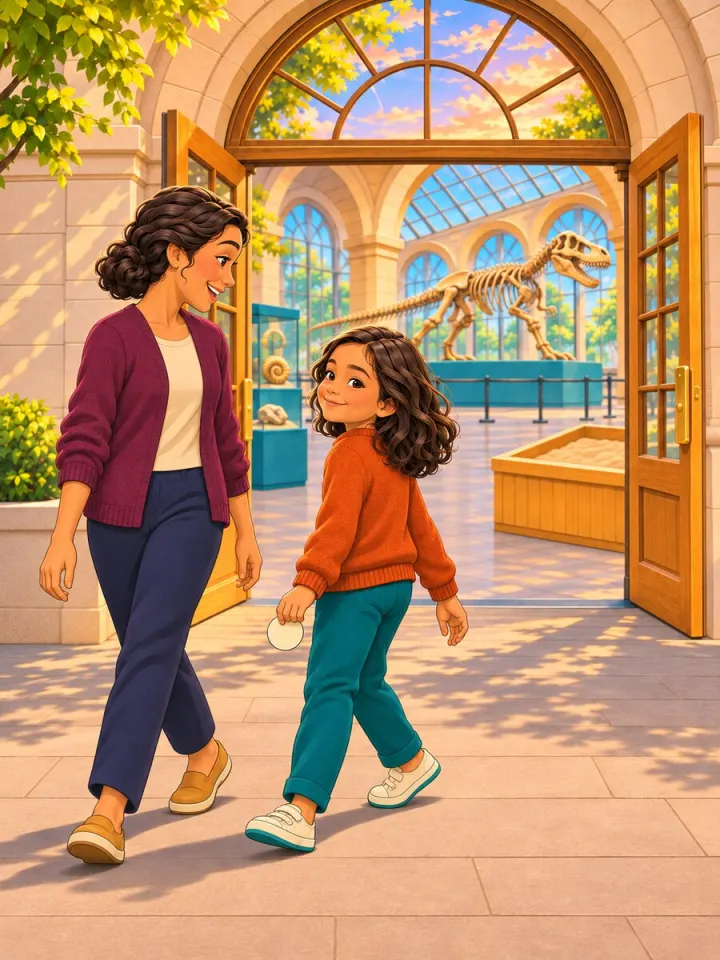
Hollis rose onto tiptoes. The elbow moved. Another coat took its place. “I think this museum is for big people,” Hollis told Dad. He bent down to listen. They stayed behind the barrier, with both feet safely on the floor. Dad suggested waiting for a clearer view, but Hollis's excitement had already begun to fold itself away.
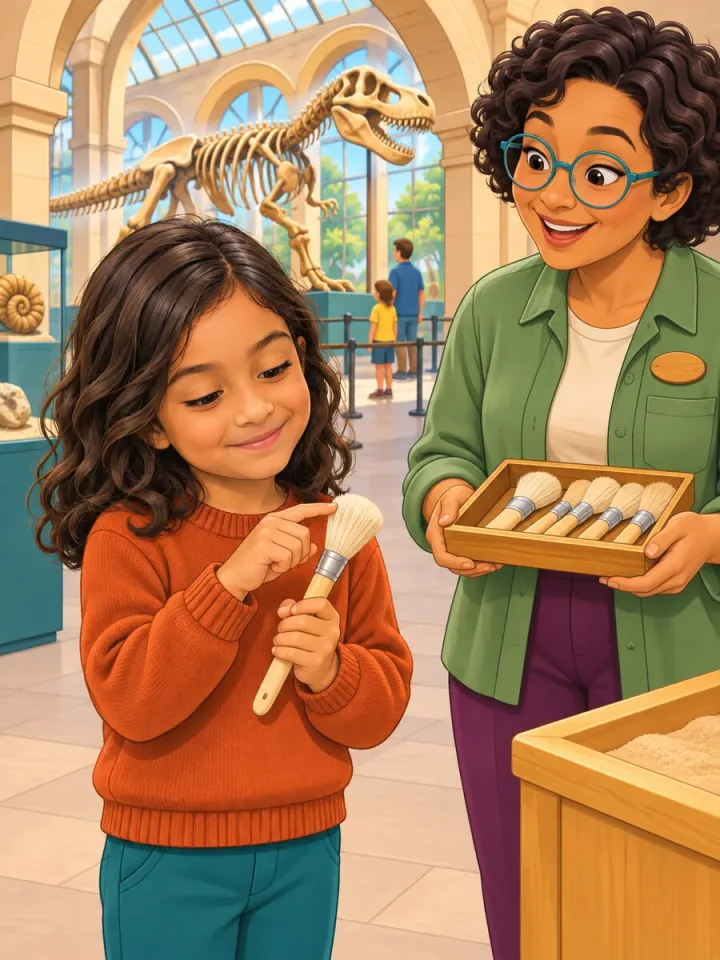
A guide carrying a tray of brushes stopped nearby. “The big bones are busy today,” the guide said. “Would you help me look for something smaller?” In an alcove stood a low wooden sandpit. “This is our practice dig. Everything buried here is a replica: a model made for handling. The real fossils stay protected.” Hollis chose a soft brush with a wooden handle.
“Palaeontologists study ancient life from fossils,” the guide explained. “They look carefully and record where things are found. Our practice sand is easy to brush. Real fossils can need much more work and specialist tools.” Hollis had imagined digging with enormous shovels. This brush was no bigger than the one used for painting a sky. Could it really uncover anything interesting?
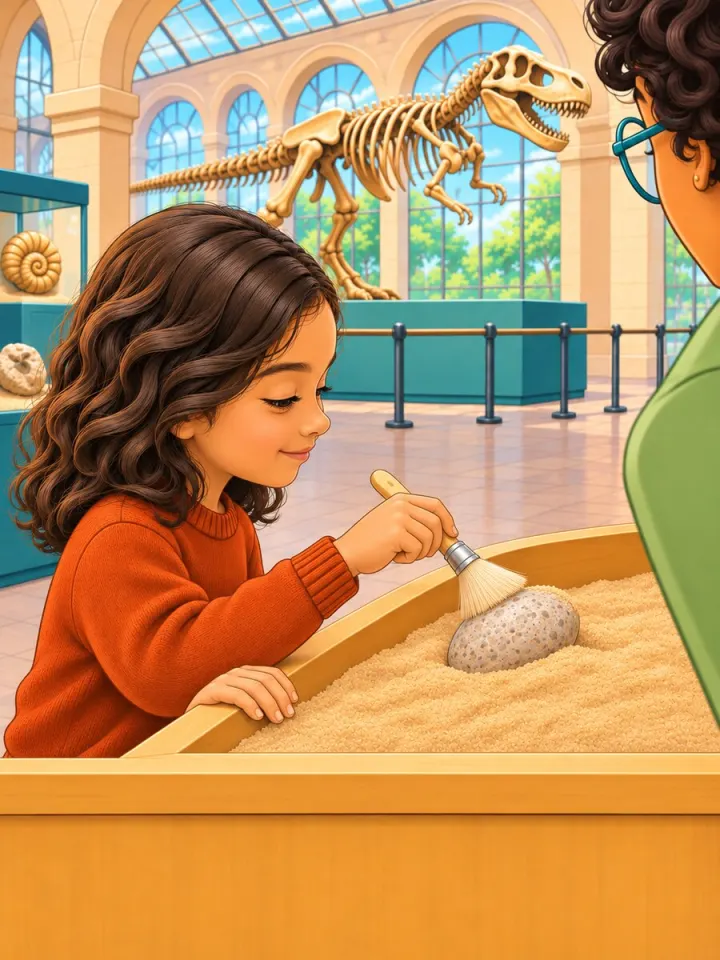
Hollis sat on the low stool and swept the sand. Swish. Swish. Nothing but more sand. Across the hall, somebody gasped at the T. rex. Hollis pressed harder, making a little ridge. The brush touched something curved. Hollis's fingers twitched. One quick pull would settle the mystery. Instead, Hollis laid the other hand flat on the wooden rim and brushed around the edge.
The curve grew. A pebble? A model bone? Hollis turned the brush and used its tip to clear a narrow patch. The sand slid away in tiny streams. There was still more underneath, and Hollis's wrist wanted a rest. Hollis stopped, loosened the grip and began again. This time, the shape appeared without any pushing at all.
“I can see an oval!” Hollis called. The guide came closer, leaving Hollis room to work. A speckled egg shape rested in the sand. “You've uncovered our dinosaur egg replica.” Hollis sat back, astonished. The quiet patch of sand had been hiding a whole beginning. “Would a real fossil egg hatch?” Hollis asked. “No. A fossil egg is ancient preserved evidence, not an egg waiting to hatch.”
But an egg in a thought could hatch. Hollis looked at the model and let a story begin. In Hollis's imagination, the museum softened into a ferny riverbank. An imaginary shell opened. Out stepped a friendly baby dinosaur with enormous feet for such a small body. A scrap of shell sat on its head. Hollis laughed. The real model remained still in the museum sand.
“You must be hungry,” Hollis told the make-believe baby. A leaf seemed a sensible offer. Then Hollis remembered to ask. “Did all dinosaurs eat plants?” The guide's voice floated into the daydream. “Herbivores ate plants. Carnivores ate other animals. Teeth and other fossil evidence give us clues.” Hollis imagined two different dinner places, far apart, and left the baby's favourite food undecided. There was more to learn before choosing.
The imagined dinosaur pattered across damp ground, leaving three-toed prints. Hollis bent to examine the trail. The footprints pointed along the riverbank. A fossil footprint could be a clue even when the animal's bones were nowhere nearby. The baby shook itself. Soft feathers fluffed along its arms. “Feathers?” Hollis asked aloud. “We have fossil evidence that some dinosaurs had feathers,” the guide replied. “Dinosaurs weren't all alike.”
Hollis imagined the baby turning back with a curious tilt of its head. It was small too. Yet its feet could leave a trail for somebody to notice. Hollis wanted to follow it around the river bend, but Dad was calling gently from the alcove. The ferns faded. So did the baby. There was the wooden rim again, warm beneath Hollis's hand.
Before explaining the discovery, Hollis drew the oval and a few speckles on the activity paper. The guide helped mark where it lay in the practice pit. Hollis nearly added a crack and a feather. Then the pencil paused. Those belonged to the imagined story. On a separate corner, Hollis drew the baby. “What I found goes here,” Hollis said. “What I made up goes over there.”
Dad crouched beside the sandpit. This time, he was the one waiting to hear. Hollis pointed without touching the egg. “It's a replica of a dinosaur egg. I cleared the sand slowly and left it where I found it. Real fossil eggs don't hatch. My baby dinosaur hatched in my imagination.” Dad smiled. “You noticed so much that I would have walked past.”
The guide offered Hollis a small paper badge. “Junior palaeontologist, for careful looking, patient hands and telling us exactly what you found.” Hollis held it against the orange jumper. Before they left, the crowd around the T. rex thinned. Hollis could see its enormous skull at last. It was wonderful. Then Hollis looked back at the little sandpit. “Dad,” Hollis said, “next time, let's see the small things too.”
Parts for your family
Add these people to the book and they play these parts, with their own faces. Anyone else you add joins the story as themselves, beside the hero.
- The Museum Guide — suits: Mother, Father, Grandmother, Grandfather, Aunt, Uncle, Someone else
- The Listening Family Member — suits: Mother, Father, Grandmother, Grandfather, Aunt, Uncle, Brother or sister, Cousin, Someone else