Key takeaways
- Separate treasured possessions, shared materials and turn-taking toys.
- Agree a realistic arrangement beforehand and make the next turn clear.
- Notice asking, taking care and returning as well as handing over.
A visiting child reaches for the favourite car. Your child hugs it to their chest: “Mine!” You say, “Come on, share,” and both voices get louder. Another playdate has become an argument about who must hand over what.
When talking about sharing toys, separate three things: a possession your child keeps for themselves, materials to use together and a toy to take turns with. A clear plan before a visit can be more useful than expecting them to give up everything immediately.
Sharing does not always mean the same thing
Using a box of crayons together requires a different arrangement from taking turns with one toy lorry. A child handing over a treasured teddy may also wonder whether they will get it back. When we say a child “won’t share”, it helps to explain what we are actually asking them to do.
Consistent sharing can be an unrealistic expectation for very young children; they need adult support to take turns and wait.[1] One disagreement about a toy does not tell you what sort of person your child will become.
Prepare three small areas before a friend arrives
Look at the play space together. Use this as an idea for arranging what you already have, rather than a shopping list:
| Area | What could go here? | What could you say? |
|---|---|---|
| Keeping for myself | A comfort toy or very special possession | “We can put this away today.” |
| Using together | Age-appropriate blocks, paper and drawing materials | “We could make something together with these.” |
| Taking turns | One toy that both children want | “Let’s agree how turns will change.” |
Putting away a few especially precious possessions before a visit is a reasonable option.[1] This does not require letting one child monopolise all the communal materials left out. Make arrangements that consider both children’s needs.
When two hands reach for the same toy
First stop any unsafe pulling. Automatically taking the toy from your child and giving it to the other child is not the only option. Try, “You both want the crane. You’re using it now, and your friend wants to know when their turn will be.”
Explain when the next turn will begin: “Could you swap after lowering this load?” If both children understand a timer, it may help; turns do not have to last exactly the same number of minutes in every game. Offer the waiting child another activity. Tell the child whose turn has ended when they can use the toy again.
If someone pushes or hits, deal with safety first: “I understand you want the toy. I won’t let you hit.” Revisit the plan when they are calmer. Young children may need repeated support through the steps of resolving conflict.[2]
What can you praise when your child is learning to share?
You can praise specific steps: “You asked before taking the car”, “You found another game while you waited” or “You gave it back when you finished.” These comments tell your child which action you appreciated. Looking after a borrowed possession matters alongside asking for it.
Model a small request yourself: “Could I borrow your pencil for a moment? I’ll put it here when I’ve finished.” If the answer is no, calmly looking for another pencil also sets an example. This does not mean nothing in a family can be shared: explain which things are communal and how those arrangements work.
Talk about asking permission with Goldilocks
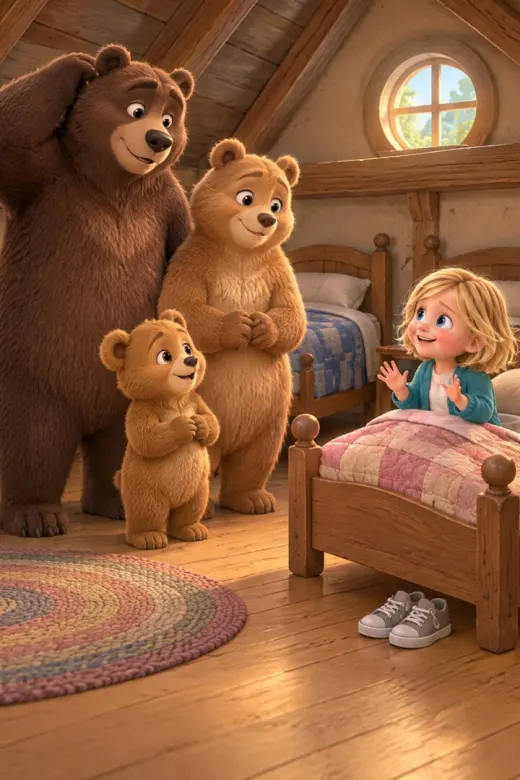
In our retelling of Goldilocks and the Three Bears, the child enters without permission, eats the food and breaks the little chair. In the sample book, the child apologises, helps fix the little chair and stirs fresh porridge. In the full tale, the bears also ask Goldilocks to knock next time. Read the full tale.
Avoid using it to say, “The bears shared everything, so you must too.” Better questions are “How could Goldilocks have asked Baby Bear about using the chair?” and “What needs putting right when someone’s belongings are damaged?” In our retelling, Goldilocks helps put things right; another edition you read may end differently.
You could draw three small pictures together: asking, taking care, giving back. This is a conversation activity suggested for the article, rather than a method guaranteed to teach sharing.
Goldilocks and the Three Bears
Too hot, too cold, just right
A fairy tale for discussing permission, caring for other people’s belongings and putting a mistake right.
Make this book with your child →Choose one change for the next visit
Everything may not be shared smoothly on the first attempt. Change just one detail next time: put a precious toy away beforehand, arrange the communal materials more clearly or plan turns with one sought-after toy. Consider your child’s age, tiredness and communication needs.
If the disagreement is more about controlling the entire game, our article on sharing decisions in play addresses that separate need.
Sources and editorial note
Age-related expectations and adult support with conflict were checked against these sources. The three-area arrangement, pictures and sample dialogue are editorial suggestions.
- Raising Children Network: Teaching children to share — an age-by-age guide
- ZERO TO THREE: 24–36 Months — Social and Emotional Development
Sources checked: 17 November 2026. Written by the I Am In The Story editorial team.
Frequently asked questions
Can a favourite toy be put away?
Putting a few especially precious things away before a visit can be an option. Make fair arrangements for the communal materials left out.
Does every toy need a timer?
No. A timer can help if both children understand it. Another clear option is swapping after an agreed step in the game.
What if someone hits?
Make things safe and state the no-hitting boundary briefly. Return to the turn-taking plan when the children are calmer.
Language:Türkçe Deutsch Français Español Italiano Nederlands Svenska Dansk Norsk