Key takeaways
- Encourage their ideas while letting other children choose their own roles.
- Try three picture cards that distribute decisions between players.
- Respect another player’s right to rest, leave or decline a part.
“You stand there. You’re the baddie. No, don’t do it like that!” Your child has an enthusiastic plan for every detail of the game, while their friends drift away one by one. They wanted to play together, but now nobody is left beside them.
When your child always wants to be in charge, you can encourage their ideas while showing them how to share decisions. This article is about who has a say in a shared game, rather than winning or handing over toys.
When does an idea turn into an order?
Inventing a detailed story, suggesting jobs and sometimes leading are not problems in themselves. Look at what happens when a friend says, “I want a different part.” Can the game change? Is one child always waiting, serving everyone else or playing a character they do not want?
Preschool children are still learning to reconcile different wishes within the same game.[1] Instead of “You’re so bossy”, describe one moment: “You suggested a spaceship and your friend wanted a hospital. How could there be room for both ideas?”
The aim is not for your child to surrender their own ideas at every disagreement. Sharing decisions includes making suggestions, trying someone else’s plan and saying when they do not want a particular role.
A short pause while the game is happening
You could step in with, “Let’s pause. Everyone can say which part they’d like.” Do not take away your child’s whole opportunity to speak. Ask them the same question: “What would you like to do?” Then help make the other child’s answer heard too.
There is no need to shame them with “Nobody’s listening, so you’re not a leader.” “We chose someone’s part for them. Let’s ask again” identifies something they can change. If there is pushing, threatening or damage, pause the game and deal with safety first.
A game with three decisions to share
Try making an imaginary city with two or three people at home. Use paper, a few toys and three large picture cards. Any small pieces should be appropriate for your child’s age. This is a practice activity created for the article.
| Card | This round’s decision | What happens next |
|---|---|---|
| Place | Is the city under the sea or above the clouds? | The chooser also listens to other ideas. |
| Project | Are we building a bridge or a park today? | A different player makes this decision. |
| New idea | What small detail shall we add? | Look for a suggestion you can include together. |
Swap the cards next round. If one player begins deciding every detail, ask, “Which card did that decision belong to?” Cards do not work magic. They help everyone see who chooses each part of the game and when it is their turn.
Praise something more specific than “a born leader”
Afterwards, try describing an observed moment: “You changed your road when your friend added the shop” or “You didn’t make them take a part they didn’t want.” This directs attention towards working together instead of controlling other people.
You can model a small change of plan too: “I had imagined the scene differently, but your idea fits as well. Let’s put them together.” It helps to remember that children learn from the way adults handle disagreement.[2]
If a friend says they do not want to play today, do not pressure them to return. Cooperation includes someone else’s right to leave or rest. You can listen to “They’ll never play with me again” without promising to bring that friend back.
What if the real disagreement is different?
If the conflict is about lending a favourite possession, our article on toy ownership and taking turns may be more useful. Sharing a decision and lending something you own are different needs.
If conflict, threats, lost friendships or intense distress occur across settings, share concrete examples with the teacher. Consider whether noise, communication difficulties or misunderstanding the game may be contributing. One behaviour does not establish a personality or developmental diagnosis. Seek suitable professional support when needed.
A team where one hero does not do every job
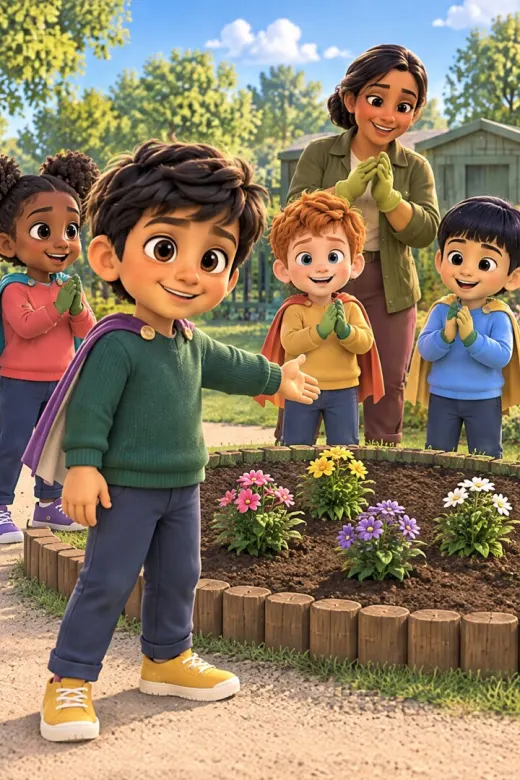
In The Superhero Team with Room for Everyone, our hero starts by giving orders and the game goes nowhere. Later they ask what their friends would like to do. One notices details, another plans the route and another helps carry things. Decisions and jobs are shared. When a friend needs a rest, the team waits.
Instead of asking who was the captain, try “What changed when the hero started asking questions?” Choose just one question for the next game: “What would you like to do?” The book cannot change a friend’s behaviour, but it offers a moment of decision to explore together.
The Superhero Team with Room for Everyone
Four capes, four different powers and room for every friend
A team story about offering ideas, listening and sharing the decisions in a joint task.
Make this book with your child →Sources and editorial note
Developing cooperation and adult modelling were checked against the sources below. The city cards and sample conversations are editorial suggestions.
- Raising Children Network: Preschooler friendships — cooperating
- American Academy of Pediatrics / HealthyChildren.org: Social Development in Preschoolers
Sources checked: 17 November 2026. Written by the I Am In The Story editorial team.
Frequently asked questions
Is enjoying leadership a problem?
Not by itself. Look at whether the game can change when another child has a different idea or does not want an assigned part.
What can I say in the moment?
Try “Everyone can say which part they’d like.” Give your child the same chance to speak as the others.
Is refusing to lend toys the same issue?
No. Ownership and taking turns with a possession are different from sharing decisions in a joint game.
Language:Türkçe Deutsch Français Español Italiano Nederlands Svenska Dansk Norsk