Key takeaways
- Listen for the specific comparison rather than reversing the ranking.
- Acknowledge real differences without tying worth to performance.
- Try a small folder for noticing change in their own work.
“Their drawing is better than mine.” “Everyone reads faster than me.” Your child points to a friend’s work without looking at their own again. You want to say, “Yours is much better.” But that answer can simply turn the same competition around.
When your child compares themselves with friends, try to understand the particular comparison and help them find a concrete way to notice their own development. Another child’s skill does not take away from their worth.
Unpack “They’re better” a little
“Which part do you think they do better?” can turn a sweeping judgement into a detail. Is it choosing colours, reading quickly or throwing a ball further? School-age children may compare themselves with classmates.[1] Hearing one comparison does not mean you need to attach a low-confidence label.
First acknowledge the feeling: “Looking at their picture seems to have made you sad about yours.” Then wait. They may want help with the drawing or simply to feel understood. Every comparison does not need a new practice programme.
Support them without denying a real difference
A friend may currently read faster or be taller. “No, that isn’t true” can dismiss something your child can see. A three-part response might be:
- “Yes, they’re reading that part faster at the moment.”
- “That doesn’t tell us how much you matter.”
- “What would you like to learn about this?”
You can also wait before the last question. Sometimes sitting together is more appropriate than solving something immediately. Show through your actions that their value is not dependent on performance.[2]
Make a progress folder together
Put a few older and newer pieces of work your child chooses in a folder. They could be drawings, a note they wrote or a photograph of something they made. Leave other children’s marks and rankings out. This is a way of noticing changes together, rather than an assessment.
Look together and ask just one question: “What has changed over time here?” Listen to the detail they choose. You may notice a straighter cut, while they value having chosen their own colours for the first time. You do not have to prove that every newer page is better.
If progress is not visible yet, do not turn the folder into pressure. The activity’s level, accessibility, teaching support and your child’s interest matter too. A possible learning difficulty deserves more than “Just believe in yourself.” Share concrete observations with their teacher.
A different way to look at basketball
NBA player Muggsy Bogues was 5 feet 3 inches tall, or about 1.60 metres.[3] This does not give every child a target of professional sport. A useful question is, “What helps a team besides being the tallest?”
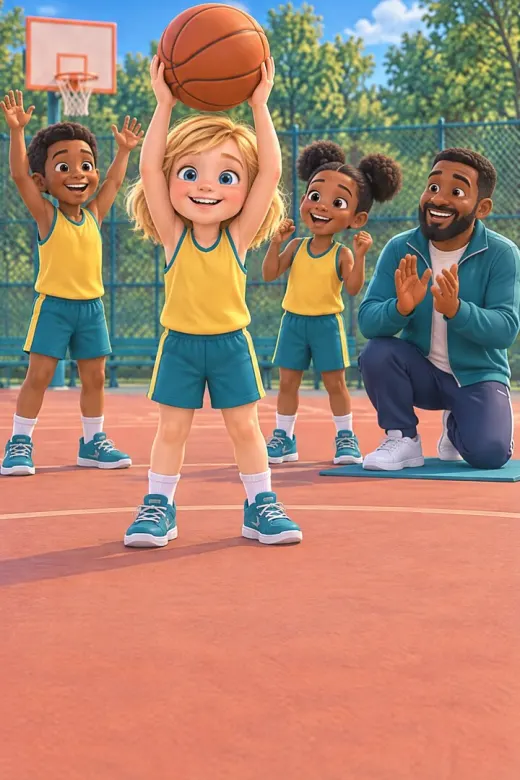
In The Basketball Spark, the shortest player first judges themselves by the taller children’s long-range shots. Then they learn a low dribble, how to read the court and when to pass. The final basket comes from a pass to a teammate, rather than the hero suddenly shooting further.
Do not turn the ending into “They became better than everyone after all.” The hero does not become the tallest player; they discover a contribution they can make. Ask, “What would they have missed if they only measured shooting distance?”
The Basketball Spark
Quick feet, one low bounce, a chance for the whole team
A child who measures themselves in just one way discovers another contribution they can make to a team.
Make this book with your child →Make room for someone else’s success too
You can say, “Your friend’s picture is lovely. I’m interested in the colours you chose as well.” Appreciating one child need not diminish another. Notice the “Look how well your sibling…” comparisons that may creep into family conversations too.
If your child mainly wants help with learning a skill, our article on breaking a task into smaller steps addresses that need. This article looks at how to help when a child treats a friend’s performance as a verdict on their own worth.
When might more support be needed?
If self-critical comments become frequent, your child avoids activities they used to enjoy or persistent sadness affects everyday life, speak with their teacher and an appropriate child-health professional. If teasing is behind the comparisons, adults need to address that behaviour too.
One sentence can be enough to begin today: “We’ve seen what they made. Now I’d like to hear how you feel.” They do not have to feel cheerful by the end of the conversation.
Sources and editorial note
Development and support information was checked against the parent resources below. The folder is an editorial activity. The sporting example is not a developmental method or a promise of success.
- Raising Children Network: Self-esteem and confidence in children
- American Academy of Pediatrics / HealthyChildren.org: Building Blocks for Healthy Self Esteem in Kids
- Charlotte Hornets 2025–26 Media Guide: All-time roster, Muggsy Bogues
Sources checked: 17 November 2026. Written by the I Am In The Story editorial team.
Frequently asked questions
Should I say they are better than their friend?
That may simply reverse the same ranking. First listen to the detail they are comparing and how they feel.
What if their friend really is faster?
You do not have to deny the difference. Explain that it does not determine their worth, and ask what support they want.
Is the progress folder a test?
No. It is a way to look at changes in work your child chooses. It should not become pressure to prove every newer piece is better.
Language:Türkçe Deutsch Français Español Italiano Nederlands Svenska Dansk Norsk