Key takeaways
- Find the exact step where the task becomes difficult.
- Choose one small action and ask what help they want before they try.
- Give specific feedback while considering rest, interest and the need for a break.
Two puzzle pieces will not fit. “I can’t do this,” your child says, closing the box. They chose the activity a moment ago; now asking them to try again only makes them more tense. You worry that helping means doing everything, while not helping means they will give up.
When a child gives up easily, first look for the small step where the task becomes difficult. Making it smaller, showing one attempt and leaving room for their turn gives a more concrete start than “Try harder.” This article focuses on learning a skill or completing an everyday activity.
Unpack “I can’t do it”
Do they think the entire job is impossible, misunderstand an instruction, have tired hands or not know where to begin? Observe before labelling. Ask, “Where exactly did you get stuck?” Two choices may be clearer for a younger child: “Is turning the piece hard, or finding its place?”
Look at whether the activity fits their current skills and interests. Something too easy can be boring; something much too hard can be overwhelming. Following curiosity and offering a manageable challenge are approaches used to support motivation.[1]
Wanting to stop does not always mean the same thing. Your child may be sleepy, hungry or no longer interested. Supporting practice does not mean ignoring every “I want to stop.”
If your child can keep playing but struggles with losing at the end, our article about crying after a game is lost addresses that separate situation.
Start with one small step
“Finish the puzzle” can feel enormous. Try “Let’s find one piece with a straight edge.” Depending on the activity, a smaller step might look like this:
| A task that feels too big | One small attempt |
|---|---|
| Drawing the whole picture | Try one shape on the paper. |
| Playing a long melody | With a music teacher’s help, work slowly on a short section. |
| Completing the puzzle | Find an edge piece and try turning it. |
| Tidying the room | Begin by gathering only the books on the floor. |
The measure here is not speed or completing everything. Choose a step your child can actually attempt. Agree the next step together afterwards. If the first one is still too hard, make it smaller.
Adjust how much help you give
Instead of taking over, ask, “Would you like me to show you once, or stay beside you?” If modelling, describe your thinking: “I’m looking for a straight edge. This side isn’t straight, so I’ll turn it and look again.” Then let your child have a go.
Before immediately correcting an unsuccessful attempt, ask about the idea: “What made you think that piece might fit here?” The answer can reveal where the difficulty lies. A break followed by another attempt is an option if the task is becoming overwhelming.[2]
If you are rushed too, say so: “I’m trying to get us out of the door. Let’s practise this together at a quieter time.” Learning does not always have to fit into the last five minutes before leaving home.
Could what we praise affect the next choice?
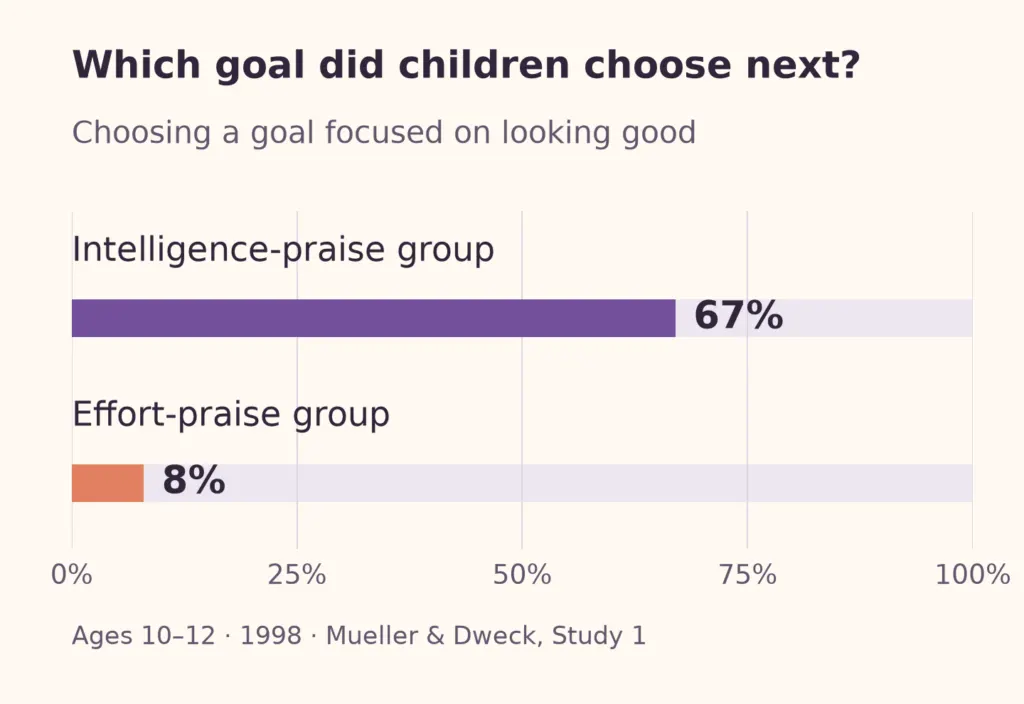
In Mueller and Dweck’s 1998 US experiment, children aged 10–12 received different kinds of praise after a task. They then chose whether to pursue learning or looking good in a subsequent task. The analysis included 123 children. In the intelligence-praise group, 67% chose a performance goal, compared with 8% in the effort-praise group.[3]
| Type of praise | Choosing a performance goal |
|---|---|
| Intelligence | 67% |
| Effort | 8% |
This older, limited experiment does not guarantee an outcome for every preschool child. Nor does it establish a rule banning “Well done.” One idea to try at home is feedback specific to what your child did: “When it didn’t fit, you turned the piece and tried another way.”
Add an observation to “You worked hard”
Rather than asking only for more effort, name what they changed, which approach they tried or what they learned. Feedback can then carry information to use on another attempt.[2]
- “This time you sorted the edge pieces first.”
- “What changed when you slowed the difficult part down?”
- “Which bit became clearer when you asked for help?”
- “That approach still didn’t work. What else could we try?”
You do not have to hide an unfinished result: “It isn’t complete yet, but you worked out how the first two pieces connect.” A believable observation about the task can begin a more useful conversation than the same extravagant praise after every attempt.
Leave an option between a break and stopping forever
Instead of arguing with “I’m never doing this again”, try, “We can pause now. Would you like to come back to one small part later?” Make the return task smaller. Listen if they do not want to return; another activity or time may be more suitable.
Leaving a course, abandoning every new activity at the first difficulty and wanting a rest today are different decisions. These suggestions concern the point where an everyday task becomes difficult. A longer-term class decision also needs a conversation about your child’s interest and the teacher’s observations.
The small sections in The Violin That Kept Playing
In our story, the hero wants to put the violin away after struggling with a fast passage. The teacher divides the music into smaller sections and demonstrates slow practice. Instead of mastering everything at once, the hero learns short sections and joins them together. Wrong notes become clues about what to practise.
This is the moment to discuss: “What did the teacher change when the whole melody was too difficult?” Return to your child’s task with “What’s one small part of our puzzle we could try?” The story’s concert result does not have to become an achievement expected of your child.
The Violin That Kept Playing
An old violin, a slow tortoise, a string that snaps
A child learns to divide a difficult melody into small sections and practise slowly.
Make this book with your child →Choose one small attempt today
Take something your child is interested in. Begin with “Which part is hard?”, “What could the first small step be?” and “What help would you like?” After trying, look at what they noticed rather than only whether the job is complete.
If difficulties span many activities, cause intense distress or significantly affect school and daily life, speak with their teacher and a professional who knows your child. Persistence is not a personality score measured by one sentence; understanding needed support means looking at the context.
Sources and editorial note
The small-step table and dialogue were created for this article. Chart values come from the original experiment and the graphic was redrawn. The study did not test our book or the effects of personalised books.
- Harvard Center on the Developing Child: How to Motivate Children — curiosity, appropriate challenge, choice and feedback; 2019.
- Stanford DREME: Help Children Build Positive Math Attitudes — thinking, specific feedback, different strategies and breaks.
- Mueller, C. M., & Dweck, C. S. (1998). Praise for Intelligence Can Undermine Children’s Motivation and Performance. Journal of Personality and Social Psychology, 75(1), 33–52. Study 1, pp. 36–37. Of 128 participants, 123 were included in the analysis.
Sources checked: 17 November 2026. Written by the I Am In The Story editorial team.
Frequently asked questions
Should I finish the task for them?
You might show one attempt, stay nearby or offer a hint. Ask what help they want, then leave room for a small step they can attempt themselves.
Does allowing a break encourage giving up?
Not every break has the same meaning. They may be tired or overwhelmed. Offer a smaller return task while considering the activity’s level and their interest.
What could I say instead of “You’re so clever”?
Try a task-specific observation: “You turned the piece and tried a different way.” If the result is unfinished, discuss what they noticed and another approach.
Language:Türkçe Deutsch Français Español Italiano Nederlands Svenska Dansk Norsk