Key takeaways
- Acknowledge disappointment and pause unsafe behaviour.
- Adapt the game beforehand rather than changing rules to erase a loss.
- Model losing respectfully and choose one question after play.
Imagine a family card game one evening. The last card lands on the table and your child’s sibling wins. A moment ago everyone was laughing. Now your child is crying, refuses to help pack away and says, “I’m never playing again!” You wonder whether deliberately losing next time would make the evening easier.
When your child cries after losing, the first support you can offer is to acknowledge disappointment and keep play safe. Instead of changing the rules to erase the loss, take a short break and talk when they are ready. How you set up the next game matters too.
You do not have to give a lesson immediately
“It’s only a game” may sound entirely reasonable to you. Your child has still missed an outcome they wanted. Rather than debating how important the game was, try, “You really wanted to win. You’re disappointed.” Offer a small choice: “Would you like to sit with me or have some water first?”
They do not have to smile or congratulate someone immediately. Allow time to recover enough to talk. Later, you can return to recognising the other player’s effort and thanking them. Children also learn respect from the way adults behave in games.[1]
Make room for tears while keeping a boundary
Listening to sadness does not mean allowing cards to be thrown or another player to be hit. State a short boundary you can follow through on: “You’re upset. I won’t let you throw the cards. We’re pausing the game now.” Make the surroundings safe first; leave the long conversation for later.
Afterwards, explore “What did you want to do?” and “What could we do instead next time?” Choose an option such as putting cards on the table, saying “I need a break” or coming to you. These are editorial examples to adapt to words your child can use.
A reaction to a game’s result and intense anger throughout daily life should not be treated as one problem. This article focuses on disappointment after a game or competition.
If the difficult moment happens while learning a skill rather than after a result, our article on supporting a child who gives up easily explores smaller learning steps.
Should you let them win every time?
You can adapt a game to your child’s level. Make the arrangement clear from the start rather than secretly steering every result in their favour. If your child will have an extra attempt, for example, explain that before the first round. Do not alter a rule midway to prevent a loss.
Short rounds and simple rules may suit younger children. You could alternate games involving some chance with cooperative tasks. Choosing age-appropriate games and agreeing rules beforehand are parts of fair play.[2]
For a game at home, try an agreement like this:
- We discuss the rules before the first round.
- We put the cards down when someone asks for a break.
- The result stays the same, and we can choose whether to play again.
- We practise thanking the people we played with.
This is not a behaviour test. If your child is finding it very hard, start with a shorter or less competitive activity. You do not need a promise that losing will never upset them again.
Let your child see you lose too
When you lose a round, describe how you feel in a few words: “I wanted to win that one. It didn’t happen. I’ll sort my cards, then try again.” Thanking the winner for playing is a concrete example too.[1]
Allow your child to enjoy winning. If celebration becomes putting someone down, step in: “You can be pleased you won. We won’t call another player useless.” Winners can learn something as well: looking after the relationship that keeps play possible.
A small reminder from tennis history
Rafael Nadal lost to Robin Söderling at Roland-Garros in 2009, his first match defeat at that tournament. The following year he faced the same opponent in the final and won the title.[3]
We cannot tell a child “He wasn’t upset” from those results. They do not reveal his feelings, and they cannot promise a win next time. The smaller idea worth discussing is: one match result is not a player’s whole story.
With a child who enjoys sport, ask, “If we watched only one match, would we know everything about that player?” If a famous sportsperson does not interest them, leave the example aside. Remembering a game you enjoyed together last week can be enough.
What could you ask instead of the result?
If “Did you win?” is always your first question after a match, try another starting point:
| What you want to notice | A question to ask |
|---|---|
| Enjoyment | “Which part did you like best?” |
| A choice they made | “What did you do when it felt difficult?” |
| The other player | “Did you notice something your friend did well?” |
| The next game | “What break plan could we use next time?” |
Do not ask every question in succession. Choose one and listen. If they do not want to talk that day, packing away together may be enough.
Continue the conversation with One Breath, Then Tennis!
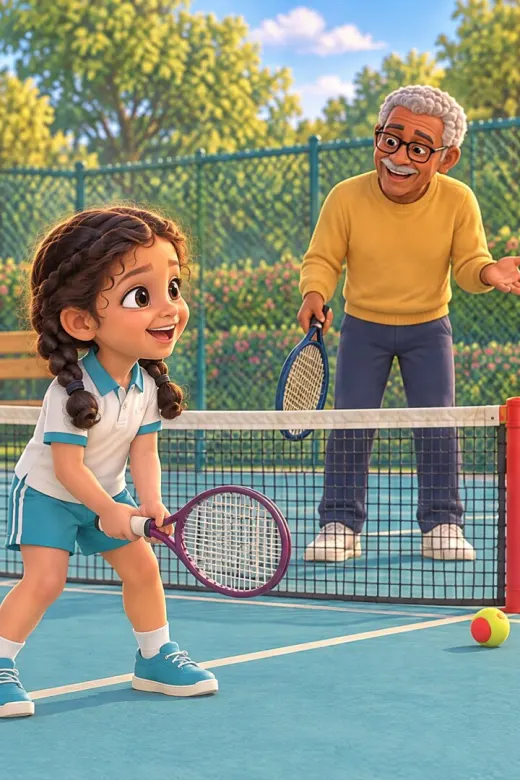
In our story, the hero throws their racket after a ball goes into the net. The coach stops play and clearly states the safety boundary. In later practice, the hero tries pausing and getting ready for the next point. At the end of the match they thank their opponent.
The hero wins the match in the story. The useful conversation is about what the hero does with the racket when frustration returns, and how they treat the opponent. Ask, “Why did the coach stop the game?” or “Where could we put what we’re holding when a game makes us angry?”
One Breath, Then Tennis!
A racket, a hot feeling, and room for the next point
A child practises a pause when play becomes frustrating and learns to respect an opponent.
Make this book with your child →Tonight’s experiment: one short round, one plan
Choose a short game your child wants to play. Before starting, agree just this: “What could we say to ask for a break if losing feels hard?” Keep the result unchanged and notice whether the plan was usable. You can simplify one thing for the next round.
If reactions repeatedly create safety problems, significantly prevent playing with friends or become too intense for your family to manage, seek support from a professional who knows your child.
Sources and editorial note
The game agreement, dialogue and table activity were created for this article. The historical example is not evidence of a treatment or behaviour change.
- Nemours KidsHealth: Teaching Kids Good Sportsmanship — adult modelling, respect and conversations after play.
- Raising Children Network: Fair play for children and parents — age-appropriate rules and experiences of winning and losing.
- ATP Tour: Nadal’s Roland-Garros story — the 2009 defeat and 2010 final results.
Sources checked: 17 November 2026. Written by the I Am In The Story editorial team.
Frequently asked questions
Should I let my child win every game?
You can adapt a game to their level and explain the arrangement before starting. Avoid secretly changing every outcome or altering rules as soon as they might lose.
Does crying mean we must stop immediately?
Crying alone is not dangerous behaviour. Listen and ask whether a break would help. If pieces are thrown or someone is hit, address safety and pause play.
Must they congratulate the winner straight away?
Allow room to recover when feelings are intense. Later you can discuss the other player’s effort and model saying thank you.
Language:Türkçe Deutsch Français Español Italiano Nederlands Svenska Dansk Norsk