Key takeaways
- Ask which part worries them; do not promise what you do not know.
- Try a toy check-up and real choices approved by the healthcare team.
- Tell the team beforehand if intense fear makes necessary care difficult.
You mention the appointment time. Your child’s first question is “Will there be a needle?” Then they do not want to put their shoes on and start crying at the door. You are trying not to be late while wondering whether “It won’t hurt” is the right thing to say.
To prepare a child who is scared of the doctor, begin by understanding which part of the visit worries them. Brief, honest explanations, a pretend check-up with a toy and a few real choices during the visit offer a starting point. This article focuses on preschool and early-primary children who can prepare through conversation and play.
What do they mean by “I’m scared of the doctor”?
For one child it is the needle; for another it is being touched by someone unfamiliar, undressing or wondering whether their parent will leave. Rather than giving everyone the same long explanation, ask, “Which part feels hardest when we go to the doctor?”
If an answer does not come, offer possibilities: “The waiting room, the examination or the chance of an injection?” Listen first. You do not need to use “You weren’t scared last time” as evidence against their current feeling.
Explain the plan if you know it. If not, “We’ll ask your doctor” is enough. Do not promise there will be no vaccination unless you know. Preparation ideas do not decide whether a visit or treatment is medically needed; those questions belong with the healthcare team.[1]
Four short ways to explain the appointment
Describe steps your child will actually encounter, in language they understand. These sentences may help you begin:
- “The doctor will check how you’re growing and may listen to your heart.”
- “We can ask them to explain before they do something.”
- “If you need a vaccination, you might feel a quick pinch. I’ll be with you.”
- “We can ask your question together.”
Say what you know rather than promising no pain or no feeling at all. Explain the purpose simply instead of tricking them into the visit. Do not make the doctor part of a threat such as “They’ll give you an injection if you’re naughty.”
You do not need to deliver a detailed medical lesson. If their question is “Where will you be?”, answer that first. If you do not know the room arrangements, say, “We’ll ask together when we go in.”
Open a little clinic for a teddy
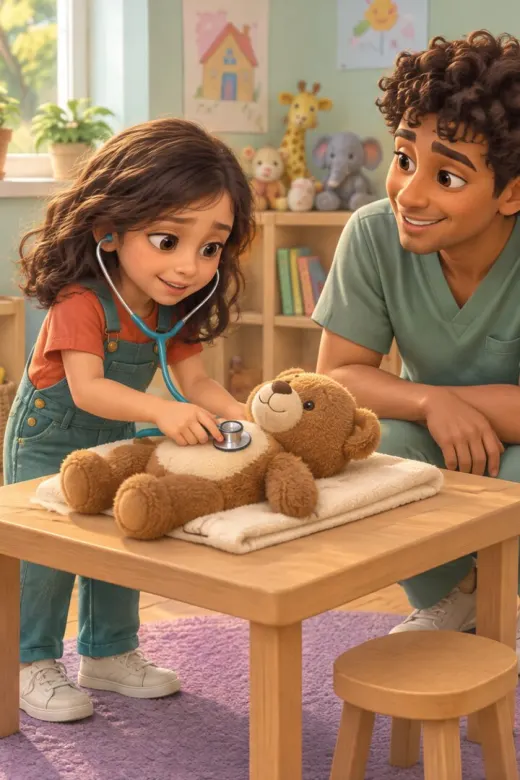
A soft toy, an empty chair and an imaginary stethoscope may be enough. Listen to the toy’s heart, ask its question and explain what you are doing. Try, “Teddy feels a bit worried. What could we say?” Your child may want to direct or simply watch. Real medicines and needles are not needed.
There is a real-world version of this idea. In a Melbourne teddy bear hospital programme established in 2009, children bring favourite soft toys to student volunteers. They act as the toy’s caregiver, take part in a pretend check-up and can ask health-related questions. A hospital visit becomes something to explore through a toy.[3]
This example does not prove that a game at home will remove fear. It offers an idea: if your child does not want to speak about themselves, start with a toy. Stop if the game makes them more tense. Preparation should suit the child too.
Which choices can belong to them on the day?
Not every decision can be left to your child. Within what the healthcare team agrees is appropriate, offer genuine choices: which toy to bring, whether to look at you during a procedure or whether to sing a song together.[2]
| What feels difficult | Something to prepare |
|---|---|
| Tension in the waiting room | Bring a familiar toy or a small book to look at together. |
| Not knowing how the doctor will examine them | Ask the team together: “Could you explain first?” |
| Not knowing where to look | Ask whether they would prefer to watch or look at you. |
| Expecting to be left alone | Discuss beforehand who can stay with them. |
If they are comfortable on your lap or close to you, ask the team about an appropriate position. Ask in advance about options to reduce discomfort rather than choosing a medicine or cream by yourself. Share any earlier procedure they found especially difficult.[2]
Crying does not mean preparation was wasted. Instead of making “brave” conditional on not crying, leave room to communicate what they need. Follow the healthcare team’s instructions about the procedure and safety.
What could you ask after the appointment?
Instead of “See, there was nothing to worry about”, ask, “Which bit was hardest?” Then try, “What helped?” Allow time if they do not want to answer.
Notice something they did: “You asked your question while your heart was being checked” or “You told me you wanted to hold my hand.” Make a small note for next time. If the rabbit helped, bring it again; if they disliked singing, consider another option. Ask the team about aftercare and any unexpected symptoms.
How can a story make room for questions?
In The Doctor with the Listening Ears, our hero worries about tomorrow’s check-up and vaccination. At a preschool teddy hospital, they ask questions while helping bandage their bear’s paw. Then they can say that they are the one who feels frightened. At the actual appointment they ask for their trusted grown-up and teddy.
There are two moments to explore: asking through a toy and requesting support at the real visit. Try, “What question might Teddy want to ask?” or “Who did the hero want nearby? What would you want?” Their answers may inform your own preparations.
A story cannot replace an examination or needed professional support. Look through it and decide whether it offers a useful way to talk with your child.
The Doctor with the Listening Ears
A teddy’s quiet heart, a brave question, a hand to hold
A child asks questions for a teddy bear and requests support at a real doctor’s visit.
Make this book with your child →When fear makes necessary care difficult
If intense fear repeatedly makes it difficult to attend or complete necessary care, tell your doctor beforehand. Explain the earlier experience, what your child reacts to and what has helped. A mental-health professional who works with children may also be appropriate for their needs.
For the next appointment, start today with one question: “What would you like to know when we go to the doctor?” Write it down together so there is a real question they can bring.
Sources and editorial note
The dialogue and home toy check-up are activities created for this article. General preparation information was checked against these sources; this is not an individual medical assessment.
- World Health Organization: Five tips for preparing children for vaccination — age-appropriate honesty and questions; 22 April 2026.
- CDC: Making Shots Less Stressful — familiar toys, comfort and options to discuss with the healthcare team.
- University of Melbourne: Teddy Bear Hospital overview — the programme’s own account of its establishment in 2009, rather than a clinical effectiveness study.
Sources checked: 17 November 2026. Written by the I Am In The Story editorial team.
Frequently asked questions
Should I say a vaccination will not hurt?
Avoid promising no pain. You can explain that there may be a quick pinch and that you will stay with them. Ask the team together if you do not know what is planned.
Does my child have to play doctors with a teddy?
No. They can direct, watch or decline the game. A toy is one preparation option, not a guarantee that fear will disappear.
Which choices can I offer during the visit?
Within what the team says is appropriate, offer choices such as the toy to bring, whether to look at you or whether to sing together.
Language:Türkçe Deutsch Français Español Italiano Nederlands Svenska Dansk Norsk